-
Notifications
You must be signed in to change notification settings - Fork 2
Expand file tree
/
Copy pathExploratory_Analysis_Demo.py
More file actions
653 lines (559 loc) · 39.9 KB
/
Exploratory_Analysis_Demo.py
File metadata and controls
653 lines (559 loc) · 39.9 KB
1
2
3
4
5
6
7
8
9
10
11
12
13
14
15
16
17
18
19
20
21
22
23
24
25
26
27
28
29
30
31
32
33
34
35
36
37
38
39
40
41
42
43
44
45
46
47
48
49
50
51
52
53
54
55
56
57
58
59
60
61
62
63
64
65
66
67
68
69
70
71
72
73
74
75
76
77
78
79
80
81
82
83
84
85
86
87
88
89
90
91
92
93
94
95
96
97
98
99
100
101
102
103
104
105
106
107
108
109
110
111
112
113
114
115
116
117
118
119
120
121
122
123
124
125
126
127
128
129
130
131
132
133
134
135
136
137
138
139
140
141
142
143
144
145
146
147
148
149
150
151
152
153
154
155
156
157
158
159
160
161
162
163
164
165
166
167
168
169
170
171
172
173
174
175
176
177
178
179
180
181
182
183
184
185
186
187
188
189
190
191
192
193
194
195
196
197
198
199
200
201
202
203
204
205
206
207
208
209
210
211
212
213
214
215
216
217
218
219
220
221
222
223
224
225
226
227
228
229
230
231
232
233
234
235
236
237
238
239
240
241
242
243
244
245
246
247
248
249
250
251
252
253
254
255
256
257
258
259
260
261
262
263
264
265
266
267
268
269
270
271
272
273
274
275
276
277
278
279
280
281
282
283
284
285
286
287
288
289
290
291
292
293
294
295
296
297
298
299
300
301
302
303
304
305
306
307
308
309
310
311
312
313
314
315
316
317
318
319
320
321
322
323
324
325
326
327
328
329
330
331
332
333
334
335
336
337
338
339
340
341
342
343
344
345
346
347
348
349
350
351
352
353
354
355
356
357
358
359
360
361
362
363
364
365
366
367
368
369
370
371
372
373
374
375
376
377
378
379
380
381
382
383
384
385
386
387
388
389
390
391
392
393
394
395
396
397
398
399
400
401
402
403
404
405
406
407
408
409
410
411
412
413
414
415
416
417
418
419
420
421
422
423
424
425
426
427
428
429
430
431
432
433
434
435
436
437
438
439
440
441
442
443
444
445
446
447
448
449
450
451
452
453
454
455
456
457
458
459
460
461
462
463
464
465
466
467
468
469
470
471
472
473
474
475
476
477
478
479
480
481
482
483
484
485
486
487
488
489
490
491
492
493
494
495
496
497
498
499
500
501
502
503
504
505
506
507
508
509
510
511
512
513
514
515
516
517
518
519
520
521
522
523
524
525
526
527
528
529
530
531
532
533
534
535
536
537
538
539
540
541
542
543
544
545
546
547
548
549
550
551
552
553
554
555
556
557
558
559
560
561
562
563
564
565
566
567
568
569
570
571
572
573
574
575
576
577
578
579
580
581
582
583
584
585
586
587
588
589
590
591
592
593
594
595
596
597
598
599
600
601
602
603
604
605
606
607
608
609
610
611
612
613
614
615
616
617
618
619
620
621
622
623
624
625
626
627
628
629
630
631
632
633
634
635
636
637
638
639
640
641
642
643
644
645
646
647
648
649
650
651
# %% [markdown]
# [](https://colab.research.google.com/github/TransformerLensOrg/TransformerLens/blob/main/demos/Exploratory_Analysis_Demo.ipynb)
# %% [markdown]
# # Exploratory Analysis Demo
#
# This notebook demonstrates how to use the
# [TransformerLens](https://github.com/TransformerLensOrg/TransformerLens/) library to perform exploratory
# analysis. The notebook tries to replicate the analysis of the Indirect Object Identification circuit
# in the [Interpretability in the Wild](https://arxiv.org/abs/2211.00593) paper.
# %% [markdown]
# ## Tips for Reading This
#
# * If running in Google Colab, go to Runtime > Change Runtime Type and select GPU as the hardware
# accelerator.
# * Look up unfamiliar terms in [the mech interp explainer](https://neelnanda.io/glossary)
# * You can run all this code for yourself
# * The graphs are interactive
# * Use the table of contents pane in the sidebar to navigate (in Colab) or VSCode's "Outline" in the
# explorer tab.
# * Collapse irrelevant sections with the dropdown arrows
# * Search the page using the search in the sidebar (with Colab) not CTRL+F
# %% [markdown]
# ## Setup
# %% [markdown]
# ### Environment Setup (ignore)
# %% [markdown]
# **You can ignore this part:** It's just for use internally to setup the tutorial in different
# environments. You can delete this section if using in your own repo.
# %% [markdown]
# ### Imports
# %%
from functools import partial
from typing import List, Optional, Union
import einops
import numpy as np
import plotly.express as px
import plotly.io as pio
import torch
from circuitsvis.attention import attention_heads
from fancy_einsum import einsum
from IPython.display import HTML, IFrame
from jaxtyping import Float
import transformer_lens.utils as utils
from transformer_lens import ActivationCache, HookedTransformer
from transformer_lens.model_bridge import TransformerBridge
# %% [markdown]
# ### PyTorch Setup
# %% [markdown]
# We turn automatic differentiation off, to save GPU memory, as this notebook focuses on model inference not model training.
# %%
torch.set_grad_enabled(False)
print("Disabled automatic differentiation")
# %% [markdown]
# ### Plotting Helper Functions (ignore)
# %% [markdown]
# Some plotting helper functions are included here (for simplicity).
# %%
def imshow(tensor, **kwargs):
px.imshow(
utils.to_numpy(tensor),
color_continuous_midpoint=0.0,
color_continuous_scale="RdBu",
**kwargs,
).show()
def line(tensor, **kwargs):
px.line(
y=utils.to_numpy(tensor),
**kwargs,
).show()
def scatter(x, y, xaxis="", yaxis="", caxis="", **kwargs):
x = utils.to_numpy(x)
y = utils.to_numpy(y)
px.scatter(
y=y,
x=x,
labels={"x": xaxis, "y": yaxis, "color": caxis},
**kwargs,
).show()
# %% [markdown]
# ## Introduction
#
# This is a demo notebook for [TransformerLens](https://github.com/TransformerLensOrg/TransformerLens), a library for mechanistic interpretability of GPT-2 style transformer language models. A core design principle of the library is to enable exploratory analysis - one of the most fun parts of mechanistic interpretability compared to normal ML is the extremely short feedback loops! The point of this library is to keep the gap between having an experiment idea and seeing the results as small as possible, to make it easy for **research to feel like play** and to enter a flow state.
#
# The goal of this notebook is to demonstrate what exploratory analysis looks like in practice with the library. I use my standard toolkit of basic mechanistic interpretability techniques to try interpreting a real circuit in GPT-2 small. Check out [the main demo](https://colab.research.google.com/github/TransformerLensOrg/TransformerLens/blob/main/demos/Main_Demo.ipynb) for an introduction to the library and how to use it.
#
# Stylistically, I will go fairly slowly and explain in detail what I'm doing and why, aiming to help convey how to do this kind of research yourself! But the code itself is written to be simple and generic, and easy to copy and paste into your own projects for different tasks and models.
#
# Details tags contain asides, flavour + interpretability intuitions. These are more in the weeds and you don't need to read them or understand them, but they're helpful if you want to learn how to do mechanistic interpretability yourself! I star the ones I think are most important.
# <details><summary>(*) Example details tag</summary>Example aside!</details>
# %% [markdown]
# ### Indirect Object Identification
#
# The first step when trying to reverse engineer a circuit in a model is to identify *what* capability
# I want to reverse engineer. Indirect Object Identification is a task studied in Redwood Research's
# excellent [Interpretability in the Wild](https://arxiv.org/abs/2211.00593) paper (see [my interview
# with the authors](https://www.youtube.com/watch?v=gzwj0jWbvbo) or [Kevin Wang's Twitter
# thread](https://threadreaderapp.com/thread/1587601532639494146.html) for an overview). The task is
# to complete sentences like "After John and Mary went to the shops, John gave a bottle of milk to"
# with " Mary" rather than " John".
#
# In the paper they rigorously reverse engineer a 26 head circuit, with 7 separate categories of heads
# used to perform this capability. Their rigorous methods are fairly involved, so in this notebook,
# I'm going to skimp on rigour and instead try to speed run the process of finding suggestive evidence
# for this circuit!
#
# The circuit they found roughly breaks down into three parts:
# 1. Identify what names are in the sentence
# 2. Identify which names are duplicated
# 3. Predict the name that is *not* duplicated
# %% [markdown]
# The first step is to load in our model, GPT-2 Small, a 12 layer and 80M parameter transformer with `HookedTransformer.from_pretrained`. The various flags are simplifications that preserve the model's output but simplify its internals.
# %%
# NBVAL_IGNORE_OUTPUT
model = TransformerBridge.boot_transformers(
"gpt2",
center_unembed=True,
center_writing_weights=True,
fold_ln=True,
refactor_factored_attn_matrices=True,
)
# Get the default device used
device: torch.device = utils.get_device()
# %% [markdown]
# The next step is to verify that the model can *actually* do the task! Here we use `utils.test_prompt`, and see that the model is significantly better at predicting Mary than John!
#
# <details><summary>Asides:</summary>
#
# Note: If we were being careful, we'd want to run the model on a range of prompts and find the average performance
#
# `prepend_bos` is a flag to add a BOS (beginning of sequence) to the start of the prompt. GPT-2 was not trained with this, but I find that it often makes model behaviour more stable, as the first token is treated weirdly.
# </details>
# %%
example_prompt = "After John and Mary went to the store, John gave a bottle of milk to"
example_answer = " Mary"
utils.test_prompt(example_prompt, example_answer, model, prepend_bos=True)
# %% [markdown]
# We now want to find a reference prompt to run the model on. Even though our ultimate goal is to reverse engineer how this behaviour is done in general, often the best way to start out in mechanistic interpretability is by zooming in on a concrete example and understanding it in detail, and only *then* zooming out and verifying that our analysis generalises.
#
# We'll run the model on 4 instances of this task, each prompt given twice - one with the first name as the indirect object, one with the second name. To make our lives easier, we'll carefully choose prompts with single token names and the corresponding names in the same token positions.
#
# <details> <summary>(*) <b>Aside on tokenization</b></summary>
#
# We want models that can take in arbitrary text, but models need to have a fixed vocabulary. So the solution is to define a vocabulary of **tokens** and to deterministically break up arbitrary text into tokens. Tokens are, essentially, subwords, and are determined by finding the most frequent substrings - this means that tokens vary a lot in length and frequency!
#
# Tokens are a *massive* headache and are one of the most annoying things about reverse engineering language models... Different names will be different numbers of tokens, different prompts will have the relevant tokens at different positions, different prompts will have different total numbers of tokens, etc. Language models often devote significant amounts of parameters in early layers to convert inputs from tokens to a more sensible internal format (and do the reverse in later layers). You really, really want to avoid needing to think about tokenization wherever possible when doing exploratory analysis (though, of course, it's relevant later when trying to flesh out your analysis and make it rigorous!). HookedTransformer comes with several helper methods to deal with tokens: `to_tokens, to_string, to_str_tokens, to_single_token, get_token_position`
#
# **Exercise:** I recommend using `model.to_str_tokens` to explore how the model tokenizes different strings. In particular, try adding or removing spaces at the start, or changing capitalization - these change tokenization!</details>
# %%
prompt_format = [
"When John and Mary went to the shops,{} gave the bag to",
"When Tom and James went to the park,{} gave the ball to",
"When Dan and Sid went to the shops,{} gave an apple to",
"After Martin and Amy went to the park,{} gave a drink to",
]
names = [
(" Mary", " John"),
(" Tom", " James"),
(" Dan", " Sid"),
(" Martin", " Amy"),
]
# List of prompts
prompts = []
# List of answers, in the format (correct, incorrect)
answers = []
# List of the token (ie an integer) corresponding to each answer, in the format (correct_token, incorrect_token)
answer_tokens = []
for i in range(len(prompt_format)):
for j in range(2):
answers.append((names[i][j], names[i][1 - j]))
answer_tokens.append(
(
model.to_single_token(answers[-1][0]),
model.to_single_token(answers[-1][1]),
)
)
# Insert the *incorrect* answer to the prompt, making the correct answer the indirect object.
prompts.append(prompt_format[i].format(answers[-1][1]))
answer_tokens = torch.tensor(answer_tokens).to(device)
print(prompts)
print(answers)
# %% [markdown]
# **Gotcha**: It's important that all of your prompts have the same number of tokens. If they're different lengths, then the position of the "final" logit where you can check logit difference will differ between prompts, and this will break the below code. The easiest solution is just to choose your prompts carefully to have the same number of tokens (you can eg add filler words like The, or newlines to start).
#
# There's a range of other ways of solving this, eg you can index more intelligently to get the final logit. A better way is to just use left padding by setting `model.tokenizer.padding_side = 'left'` before tokenizing the inputs and running the model; this way, you can use something like `logits[:, -1, :]` to easily access the final token outputs without complicated indexing. TransformerLens checks the value of `padding_side` of the tokenizer internally, and if the flag is set to be `'left'`, it adjusts the calculation of absolute position embedding and causal masking accordingly.
#
# In this demo, though, we stick to using the prompts of the same number of tokens because we want to show some visualisations aggregated along the batch dimension later in the demo.
# %%
for prompt in prompts:
str_tokens = model.to_str_tokens(prompt)
print("Prompt length:", len(str_tokens))
print("Prompt as tokens:", str_tokens)
# %% [markdown]
# We now run the model on these prompts and use `run_with_cache` to get both the logits and a cache of all internal activations for later analysis
# %%
tokens = model.to_tokens(prompts, prepend_bos=True)
# Run the model and cache all activations
original_logits, cache = model.run_with_cache(tokens)
# %% [markdown]
# We'll later be evaluating how model performance differs upon performing various interventions, so it's useful to have a metric to measure model performance. Our metric here will be the **logit difference**, the difference in logit between the indirect object's name and the subject's name (eg, `logit(Mary)-logit(John)`).
# %%
def logits_to_ave_logit_diff(logits, answer_tokens, per_prompt=False):
# Only the final logits are relevant for the answer
final_logits = logits[:, -1, :]
answer_logits = final_logits.gather(dim=-1, index=answer_tokens)
answer_logit_diff = answer_logits[:, 0] - answer_logits[:, 1]
if per_prompt:
return answer_logit_diff
else:
return answer_logit_diff.mean()
print(
"Per prompt logit difference:",
logits_to_ave_logit_diff(original_logits, answer_tokens, per_prompt=True)
.detach()
.cpu()
.round(decimals=3),
)
original_average_logit_diff = logits_to_ave_logit_diff(original_logits, answer_tokens)
print(
"Average logit difference:",
round(logits_to_ave_logit_diff(original_logits, answer_tokens).item(), 3),
)
# %% [markdown]
# We see that the average logit difference is 3.5 - for context, this represents putting an $e^{3.5}\approx 33\times$ higher probability on the correct answer.
# %% [markdown]
# ## Brainstorm What's Actually Going On (Optional)
#
# Before diving into running experiments, it's often useful to spend some time actually reasoning about how the behaviour in question could be implemented in the transformer. **This is optional, and you'll likely get the most out of engaging with this section if you have a decent understanding already of what a transformer is and how it works!**
#
# You don't have to do this and forming hypotheses after exploration is also reasonable, but I think it's often easier to explore and interpret results with some grounding in what you might find. In this particular case, I'm cheating somewhat, since I know the answer, but I'm trying to simulate the process of reasoning about it!
#
# Note that often your hypothesis will be wrong in some ways and often be completely off. We're doing science here, and the goal is to understand how the model *actually* works, and to form true beliefs! There are two separate traps here at two extremes that it's worth tracking:
# * Confusion: Having no hypotheses at all, getting a lot of data and not knowing what to do with it, and just floundering around
# * Dogmatism: Being overconfident in an incorrect hypothesis and being unwilling to let go of it when reality contradicts you, or flinching away from running the experiments that might disconfirm it.
#
# **Exercise:** Spend some time thinking through how you might imagine this behaviour being implemented in a transformer. Try to think through this for yourself before reading through my thoughts!
#
# <details> <summary>(*) <b>My reasoning</b></summary>
#
# <h3>Brainstorming:</h3>
#
# So, what's hard about the task? Let's focus on the concrete example of the first prompt, "When John and Mary went to the shops, John gave the bag to" -> " Mary".
#
# A good starting point is thinking though whether a tiny model could do this, eg a <a href="https://transformer-circuits.pub/2021/framework/index.html">1L Attn-Only model</a>. I'm pretty sure the answer is no! Attention is really good at the primitive operations of looking nearby, or copying information. I can believe a tiny model could figure out that at `to` it should look for names and predict that those names came next (eg the skip trigram " John...to -> John"). But it's much harder to tell how <i>many</i> of each previous name there are - attending 0.3 to each copy of John will look exactly the same as attending 0.6 to a single John token. So this will be pretty hard to figure out on the " to" token!
#
# The natural place to break this symmetry is on the second " John" token - telling whether there is an earlier copy of the <i>current</i> token should be a much easier task. So I might expect there to be a head which detects duplicate tokens on the second " John" token, and then another head which moves that information from the second " John" token to the " to" token.
#
# The model then needs to learn to predict " Mary" and <i>not</i> " John". I can see two natural ways to do this:
# 1. Detect all preceding names and move this information to " to" and then delete the any name corresponding to the duplicate token feature. This feels easier done with a non-linearity, since precisely cancelling out vectors is hard, so I'd imagine an MLP layer deletes the " John" direction of the residual stream
# 2. Have a head which attends to all previous names, but where the duplicate token features <i>inhibit</i> it from attending to specific names. So this only attends to Mary. And then the output of this head maps to the logits.
#
# (Spoiler: It's the second one).
#
# <h3>Experiment Ideas</h3>
#
# A test that could distinguish these two is to look at which components of the model add directly to the logits - if it's mostly attention heads which attend to " Mary" and to neither " John" it's probably hypothesis 2, if it's mostly MLPs it's probably hypothesis 1.
#
# And we should be able to identify duplicate token heads by finding ones which attend from " John" to " John", and whose outputs are then moved to the " to" token by V-Composition with another head (Spoiler: It's more complicated than that!)
#
# Note that all of the above reasoning is very simplistic and could easily break in a real model! There'll be significant parts of the model that figure out whether to use this circuit at all (we don't want to inhibit duplicated names when, eg, figuring out what goes at the start of the <i>next</i> sentence), and may be parts towards the end of the model that do "post-processing" just before the final output. But it's a good starting point for thinking about what's going on.
# %% [markdown]
# ## Direct Logit Attribution
# %% [markdown]
# *Look up unfamiliar terms in the [mech interp explainer](https://neelnanda.io/glossary)*
#
# Further, the easiest part of the model to understand is the output - this is what the model is trained to optimize, and so it can always be directly interpreted! Often the right approach to reverse engineering a circuit is to start at the end, understand how the model produces the right answer, and to then work backwards. The main technique used to do this is called **direct logit attribution**
#
# **Background:** The central object of a transformer is the **residual stream**. This is the sum of the outputs of each layer and of the original token and positional embedding. Importantly, this means that any linear function of the residual stream can be perfectly decomposed into the contribution of each layer of the transformer. Further, each attention layer's output can be broken down into the sum of the output of each head (See [A Mathematical Framework for Transformer Circuits](https://transformer-circuits.pub/2021/framework/index.html) for details), and each MLP layer's output can be broken down into the sum of the output of each neuron (and a bias term for each layer).
#
# The logits of a model are `logits=Unembed(LayerNorm(final_residual_stream))`. The Unembed is a linear map, and LayerNorm is approximately a linear map, so we can decompose the logits into the sum of the contributions of each component, and look at which components contribute the most to the logit of the correct token! This is called **direct logit attribution**. Here we look at the direct attribution to the logit difference!
#
# <details> <summary>(*) <b>Background and motivation of the logit difference</b></summary>
#
# Logit difference is actually a *really* nice and elegant metric and is a particularly nice aspect of the setup of Indirect Object Identification. In general, there are two natural ways to interpret the model's outputs: the output logits, or the output log probabilities (or probabilities).
#
# The logits are much nicer and easier to understand, as noted above. However, the model is trained to optimize the cross-entropy loss (the average of log probability of the correct token). This means it does not directly optimize the logits, and indeed if the model adds an arbitrary constant to every logit, the log probabilities are unchanged.
#
# But `log_probs == logits.log_softmax(dim=-1) == logits - logsumexp(logits)`, and so `log_probs(" Mary") - log_probs(" John") = logits(" Mary") - logits(" John")` - the ability to add an arbitrary constant cancels out!
#
# Further, the metric helps us isolate the precise capability we care about - figuring out *which* name is the Indirect Object. There are many other components of the task - deciding whether to return an article (the) or pronoun (her) or name, realising that the sentence wants a person next at all, etc. By taking the logit difference we control for all of that.
#
# Our metric is further refined, because each prompt is repeated twice, for each possible indirect object. This controls for irrelevant behaviour such as the model learning that John is a more frequent token than Mary (this actually happens! The final layernorm bias increases the John logit by 1 relative to the Mary logit)
#
# </details>
#
# <details> <summary>Ignoring LayerNorm</summary>
#
# LayerNorm is an analogous normalization technique to BatchNorm (that's friendlier to massive parallelization) that transformers use. Every time a transformer layer reads information from the residual stream, it applies a LayerNorm to normalize the vector at each position (translating to set the mean to 0 and scaling to set the variance to 1) and then applying a learned vector of weights and biases to scale and translate the normalized vector. This is *almost* a linear map, apart from the scaling step, because that divides by the norm of the vector and the norm is not a linear function. (The `fold_ln` flag when loading a model factors out all the linear parts).
#
# But if we fixed the scale factor, the LayerNorm would be fully linear. And the scale of the residual stream is a global property that's a function of *all* components of the stream, while in practice there is normally just a few directions relevant to any particular component, so in practice this is an acceptable approximation. So when doing direct logit attribution we use the `apply_ln` flag on the `cache` to apply the global layernorm scaling factor to each constant. See [my clean GPT-2 implementation](https://colab.research.google.com/github/TransformerLensOrg/TransformerLens/blob/clean-transformer-demo/Clean_Transformer_Demo.ipynb#scrollTo=Clean_Transformer_Implementation) for more on LayerNorm.
# </details>
# %% [markdown]
# Getting an output logit is equivalent to projecting onto a direction in the residual stream. We use `model.tokens_to_residual_directions` to map the answer tokens to that direction, and then convert this to a logit difference direction for each batch
# %%
answer_residual_directions = model.tokens_to_residual_directions(answer_tokens)
print("Answer residual directions shape:", answer_residual_directions.shape)
logit_diff_directions = (
answer_residual_directions[:, 0] - answer_residual_directions[:, 1]
)
print("Logit difference directions shape:", logit_diff_directions.shape)
# %% [markdown]
# To verify that this works, we can apply this to the final residual stream for our cached prompts (after applying LayerNorm scaling) and verify that we get the same answer.
#
# <details> <summary>Technical details</summary>
#
# `logits = Unembed(LayerNorm(final_residual_stream))`, so we technically need to account for the centering, and then learned translation and scaling of the layernorm, not just the variance 1 scaling.
#
# The centering is accounted for with the preprocessing flag `center_writing_weights` which ensures that every weight matrix writing to the residual stream has mean zero.
#
# The learned scaling is folded into the unembedding weights `model.unembed.W_U` via `W_U_fold = layer_norm.weights[:, None] * unembed.W_U`
#
# The learned translation is folded to `model.unembed.b_U`, a bias added to the logits (note that GPT-2 is not trained with an existing `b_U`). This roughly represents unigram statistics. But we can ignore this because each prompt occurs twice with names in the opposite order, so this perfectly cancels out.
#
# Note that rather than using layernorm scaling we could just study cache["ln_final.hook_normalised"]
#
# </details>
# %%
# cache syntax - resid_post is the residual stream at the end of the layer, -1 gets the final layer. The general syntax is [activation_name, layer_index, sub_layer_type].
final_residual_stream = cache["resid_post", -1]
print("Final residual stream shape:", final_residual_stream.shape)
final_token_residual_stream = final_residual_stream[:, -1, :]
# Apply LayerNorm scaling
# pos_slice is the subset of the positions we take - here the final token of each prompt
scaled_final_token_residual_stream = cache.apply_ln_to_stack(
final_token_residual_stream, layer=-1, pos_slice=-1
)
average_logit_diff = einsum(
"batch d_model, batch d_model -> ",
scaled_final_token_residual_stream,
logit_diff_directions,
) / len(prompts)
print("Calculated average logit diff:", round(average_logit_diff.item(), 3))
print("Original logit difference:", round(original_average_logit_diff.item(), 3))
# %% [markdown]
# ### Logit Lens
# %% [markdown]
# We can now decompose the residual stream! First we apply a technique called the [**logit lens**](https://www.alignmentforum.org/posts/AcKRB8wDpdaN6v6ru/interpreting-gpt-the-logit-lens) - this looks at the residual stream after each layer and calculates the logit difference from that. This simulates what happens if we delete all subsequence layers.
# %%
def residual_stack_to_logit_diff(
residual_stack: Float[torch.Tensor, "components batch d_model"],
cache: ActivationCache,
) -> float:
scaled_residual_stack = cache.apply_ln_to_stack(
residual_stack, layer=-1, pos_slice=-1
)
return einsum(
"... batch d_model, batch d_model -> ...",
scaled_residual_stack,
logit_diff_directions,
) / len(prompts)
# %% [markdown]
# Fascinatingly, we see that the model is utterly unable to do the task until layer 7, almost all performance comes from attention layer 9, and performance actually *decreases* from there.
#
# **Note:** Hover over each data point to see what residual stream position it's from!
#
# <details> <summary>Details on `accumulated_resid`</summary>
# **Key:** `n_pre` means the residual stream at the start of layer n, `n_mid` means the residual stream after the attention part of layer n (`n_post` is the same as `n+1_pre` so is not included)
#
# * `layer` is the layer for which we input the residual stream (this is used to identify *which* layer norm scaling factor we want)
# * `incl_mid` is whether to include the residual stream in the middle of a layer, ie after attention & before MLP
# * `pos_slice` is the subset of the positions used. See `utils.Slice` for details on the syntax.
# * return_labels is whether to return the labels for each component returned (useful for plotting)
# </details>
# %% [markdown]
# ## Residual Stream
# %% [markdown]
# Lets begin by patching in the residual stream at the start of each layer and for each token position.
# %% [markdown]
# We first create a set of corrupted tokens - where we swap each pair of prompts to have the opposite answer.
# %%
corrupted_prompts = []
for i in range(0, len(prompts), 2):
corrupted_prompts.append(prompts[i + 1])
corrupted_prompts.append(prompts[i])
corrupted_tokens = model.to_tokens(corrupted_prompts, prepend_bos=True)
corrupted_logits, corrupted_cache = model.run_with_cache(
corrupted_tokens, return_type="logits"
)
corrupted_average_logit_diff = logits_to_ave_logit_diff(corrupted_logits, answer_tokens)
print("Corrupted Average Logit Diff", round(corrupted_average_logit_diff.item(), 2))
print("Clean Average Logit Diff", round(original_average_logit_diff.item(), 2))
# %% [markdown]
# #### Implications
#
# One implication of this is that it's useful to categories heads according to whether they occur in
# simpler circuits, so that as we look for more complex circuits we can easily look for them. This is
# easy to do here! An interesting fact about induction heads is that they work on a sequence of
# repeated random tokens - notable for being wildly off distribution from the natural language GPT-2
# was trained on. Being able to predict a model's behaviour off distribution is a good mark of success
# for mechanistic interpretability! This is a good sanity check for whether a head is an induction
# head or not.
#
# We can characterise an induction head by just giving a sequence of random tokens repeated once, and
# measuring the average attention paid from the second copy of a token to the token after the first
# copy. At the same time, we can also measure the average attention paid from the second copy of a
# token to the first copy of the token, which is the attention that the induction head would pay if it
# were a duplicate token head, and the average attention paid to the previous token to find previous
# token heads.
#
# Note that this is a superficial study of whether something is an induction head - we totally ignore
# the question of whether it actually does boost the correct token or whether it composes with a
# single previous head and how. In particular, we sometimes get anti-induction heads which suppress
# the induction-y token (no clue why!), and this technique will find those too . But given the
# previous rigorous analysis, we can be pretty confident that this picks up on some true signal about
# induction heads.
# %% [markdown]
# <details> <summary>Technical Implementation Details</summary>
# We can do this again by using hooks, this time just to access the attention patterns rather than to intervene on them.
#
# Our hook function acts on the attention pattern activation. This has the name
# "blocks.{layer}.{layer_type}.hook_{activation_name}" in general, here it's
# "blocks.{layer}.attn.hook_attn". And it has shape [batch, head_index, query_pos, token_pos]. Our
# hook function takes in the attention pattern activation, calculates the score for the relevant type
# of head, and write it to an external cache.
#
# We add in hooks using `model.run_with_hooks(tokens, fwd_hooks=[(names_filter, hook_fn)])` to
# temporarily add in the hooks and run the model, getting the resulting output. Previously
# names_filter was the name of the activation, but here it's a boolean function mapping activation
# names to whether we want to hook them or not. Here it's just whether the name ends with hook_attn.
# hook_fn must take in the two inputs activation (the activation tensor) and hook (the HookPoint
# object, which contains the name of the activation and some metadata such as the current layer).
#
# Internally our hooks use the function `tensor.diagonal`, this takes the diagonal between two
# dimensions, and allows an arbitrary offset - offset by 1 to get previous tokens, seq_len to get
# duplicate tokens (the distance to earlier copies) and seq_len-1 to get induction heads (the distance
# to the token *after* earlier copies). Different offsets give a different length of output tensor,
# and we can now just average to get a score in [0, 1] for each head
# </details>
# %%
seq_len = 100
batch_size = 2
prev_token_scores = torch.zeros((model.cfg.n_layers, model.cfg.n_heads), device=device)
def prev_token_hook(pattern, hook):
layer = hook.layer()
diagonal = pattern.diagonal(offset=1, dim1=-1, dim2=-2)
# print(diagonal)
# print(pattern)
prev_token_scores[layer] = einops.reduce(
diagonal, "batch head_index diagonal -> head_index", "mean"
)
duplicate_token_scores = torch.zeros(
(model.cfg.n_layers, model.cfg.n_heads), device=device
)
def duplicate_token_hook(pattern, hook):
layer = hook.layer()
diagonal = pattern.diagonal(offset=seq_len, dim1=-1, dim2=-2)
duplicate_token_scores[layer] = einops.reduce(
diagonal, "batch head_index diagonal -> head_index", "mean"
)
induction_scores = torch.zeros((model.cfg.n_layers, model.cfg.n_heads), device=device)
def induction_hook(pattern, hook):
layer = hook.layer()
diagonal = pattern.diagonal(offset=seq_len - 1, dim1=-1, dim2=-2)
induction_scores[layer] = einops.reduce(
diagonal, "batch head_index diagonal -> head_index", "mean"
)
torch.manual_seed(0)
original_tokens = torch.randint(
100, 20000, size=(batch_size, seq_len), device="cpu"
).to(device)
repeated_tokens = einops.repeat(
original_tokens, "batch seq_len -> batch (2 seq_len)"
).to(device)
pattern_filter = lambda act_name: act_name.endswith("hook_pattern")
loss = model.run_with_hooks(
repeated_tokens,
return_type="loss",
fwd_hooks=[
(pattern_filter, prev_token_hook),
(pattern_filter, duplicate_token_hook),
(pattern_filter, induction_hook),
],
)
print(torch.round(utils.get_corner(prev_token_scores).detach().cpu(), decimals=3))
print(torch.round(utils.get_corner(duplicate_token_scores).detach().cpu(), decimals=3))
print(torch.round(utils.get_corner(induction_scores).detach().cpu(), decimals=3))
# %% [markdown]
# We can now plot the head scores, and instantly see that the relevant early heads are induction heads or duplicate token heads (though also that there's a lot of induction heads that are *not* use - I have no idea why!).
# %% [markdown]
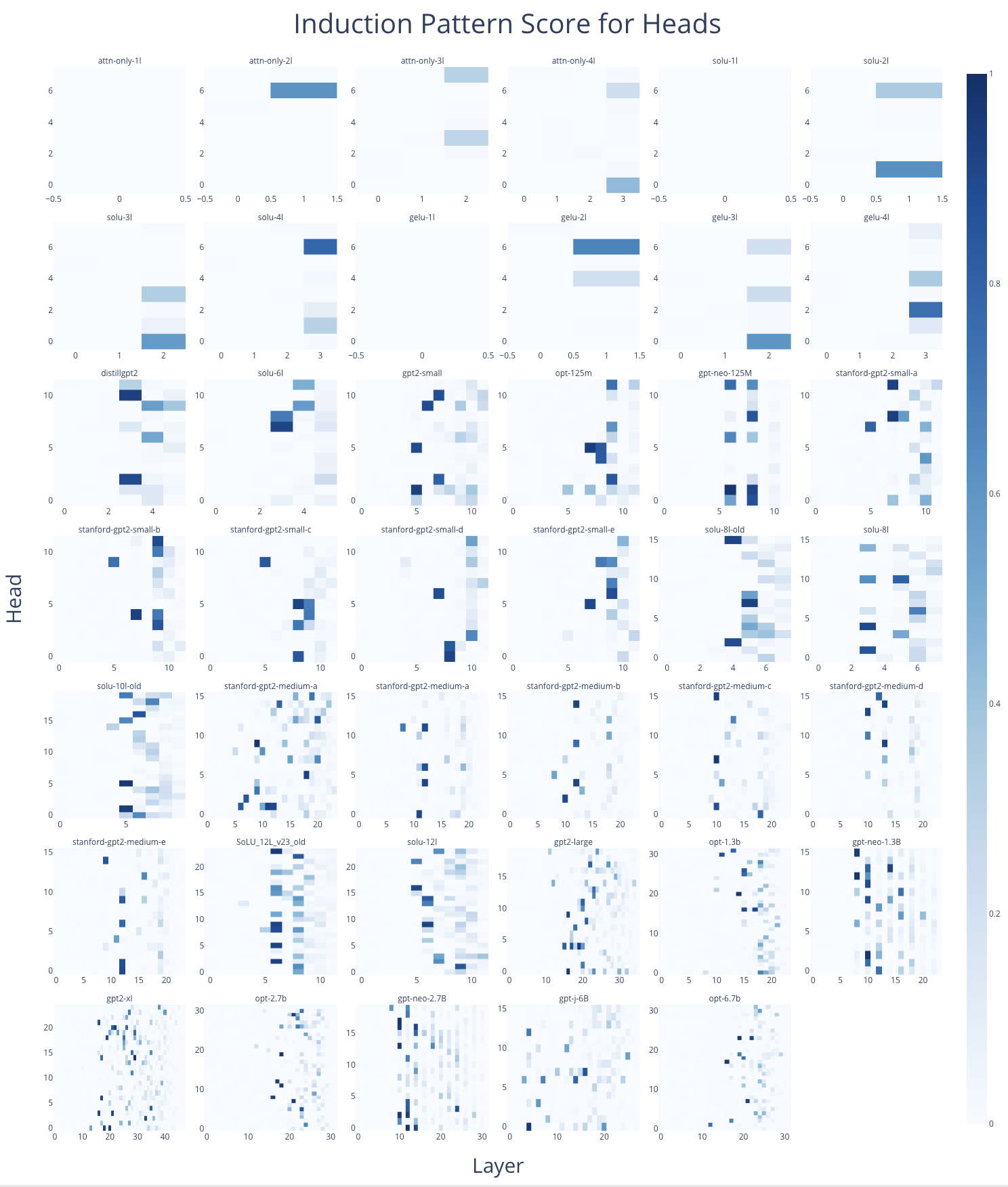
# The above suggests that it would be a useful bit of infrastructure to have a "wiki" for the heads of a model, giving their scores according to some metrics re head functions, like the ones we've seen here. TransformerLens makes this easy to make, as just changing the name input to `HookedTransformer.from_pretrained` gives a different model but in the same architecture, so the same code should work. If you want to make this, I'd love to see it!
#
# As a proof of concept, [I made a mosaic of all induction heads across the 40 models then in TransformerLens](https://www.neelnanda.io/mosaic).
#
# 
# %% [markdown]
# ### Backup Name Mover Heads
# %% [markdown]
# Another fascinating anomaly is that of the **backup name mover heads**. A standard technique to apply when interpreting model internals is ablations, or knock-out. If we run the model but intervene to set a specific head to zero, what happens? If the model is robust to this intervention, then naively we can be confident that the head is not doing anything important, and conversely if the model is much worse at the task this suggests that head was important. There are several conceptual flaws with this approach, making the evidence only suggestive, eg that the average output of the head may be far from zero and so the knockout may send it far from expected activations, breaking internals on *any* task. But it's still an easy technique to apply to give some data.
#
# But a wild finding in the paper is that models have **built in redundancy**. If we knock out one of the name movers, then there are some backup name movers in later layers that *change their behaviour* and do (some of) the job of the original name mover head. This means that naive knock-out will significantly underestimate the importance of the name movers.
#
# %% [markdown]
# Let's test this! Let's ablate the most important name mover (head L9H9) on just the final token using a custom ablation hook and then cache all new activations and compared performance. We focus on the final position because we want to specifically ablate the direct logit effect. When we do this, we see that naively, removing the top name mover should reduce the logit diff massively, from 3.55 to 0.57. **But actually, it only goes down to 2.99!**
#
# <details> <summary>Implementation Details</summary>
# Ablating heads is really easy in TransformerLens! We can just define a hook on the z activation in the relevant attention layer (recall, z is the mixed values, and comes immediately before multiplying by the output weights $W_O$). z has a head_index axis, so we can set the component for the relevant head and for position -1 to zero, and return it. (Technically we could just edit in place without returning it, but by convention we always return an edited activation).
#
# We now want to compare all internal activations with a hook, which is hard to do with the nice `run_with_hooks` API. So we can directly access the hook on the z activation with `model.blocks[layer].attn.hook_z` and call its `add_hook` method. This adds in the hook to the *global state* of the model. We can now use run_with_cache, and don't need to care about the global state, because run_with_cache internally adds a bunch of caching hooks, and then removes all hooks after the run, *including* the previously added ablation hook. This can be disabled with the reset_hooks_end flag, but here it's useful!
# </details>
# %%
top_name_mover = per_head_logit_diffs.flatten().argmax().item()
top_name_mover_layer = top_name_mover // model.cfg.n_heads
top_name_mover_head = top_name_mover % model.cfg.n_heads
print(f"Top Name Mover to ablate: L{top_name_mover_layer}H{top_name_mover_head}")
def ablate_top_head_hook(z: Float[torch.Tensor, "batch pos head_index d_head"], hook):
z[:, -1, top_name_mover_head, :] = 0
return z
# Adds a hook into global model state
model.blocks[top_name_mover_layer].attn.hook_z.add_hook(ablate_top_head_hook)
# Runs the model, temporarily adds caching hooks and then removes *all* hooks after running, including the ablation hook.
ablated_logits, ablated_cache = model.run_with_cache(tokens)
print(f"Original logit diff: {original_average_logit_diff:.2f}")
print(
f"Post ablation logit diff: {logits_to_ave_logit_diff(ablated_logits, answer_tokens).item():.2f}"
)
print(
f"Direct Logit Attribution of top name mover head: {per_head_logit_diffs.flatten()[top_name_mover].item():.2f}"
)
print(
f"Naive prediction of post ablation logit diff: {original_average_logit_diff - per_head_logit_diffs.flatten()[top_name_mover].item():.2f}"
)
# %% [markdown]
# So what's up with this? As before, we can look at the direct logit attribution of each head to see what's going on. It's easiest to interpret if plotted as a scatter plot against the initial per head logit difference.
#
# And we can see a *really* big difference in a few heads! (Hover to see labels) In particular the negative name mover L10H7 decreases its negative effect a lot, adding +1 to the logit diff, and the backup name mover L10H10 adjusts its effect to be more positive, adding +0.8 to the logit diff (with several other marginal changes). (And obviously the ablated head has gone down to zero!)
# %%
per_head_ablated_residual, labels = ablated_cache.stack_head_results(
layer=-1, pos_slice=-1, return_labels=True
)
per_head_ablated_logit_diffs = residual_stack_to_logit_diff(
per_head_ablated_residual, ablated_cache
)
per_head_ablated_logit_diffs = per_head_ablated_logit_diffs.reshape(
model.cfg.n_layers, model.cfg.n_heads
)
# %% [markdown]
# One natural hypothesis is that this is because the final LayerNorm scaling has changed, which can scale up or down the final residual stream. This is slightly true, and we can see that the typical head is a bit off from the x=y line. But the average LN scaling ratio is 1.04, and this should uniformly change *all* heads by the same factor, so this can't be sufficient
# %%
print(
"Average LN scaling ratio:",
round(
(
cache["ln_final.hook_scale"][:, -1]
/ ablated_cache["ln_final.hook_scale"][:, -1]
)
.mean()
.item(),
3,
),
)
print(
"Ablation LN scale",
ablated_cache["ln_final.hook_scale"][:, -1].detach().cpu().round(decimals=2),
)
print(
"Original LN scale",
cache["ln_final.hook_scale"][:, -1].detach().cpu().round(decimals=2),
)
# %% [markdown]
# **Exercise to the reader:** Can you finish off this analysis? What's going on here? Why are the backup name movers changing their behaviour? Why is one negative name mover becoming significantly less important?