
A de novo protein sequencing workflow



- Introduction
- Features
- Workflow Diagram
- Repository Structure
- Installation
- Command-Line Usage
- Hyperparameter Optimization
- License
- Acknowledgments
- References
- Citation
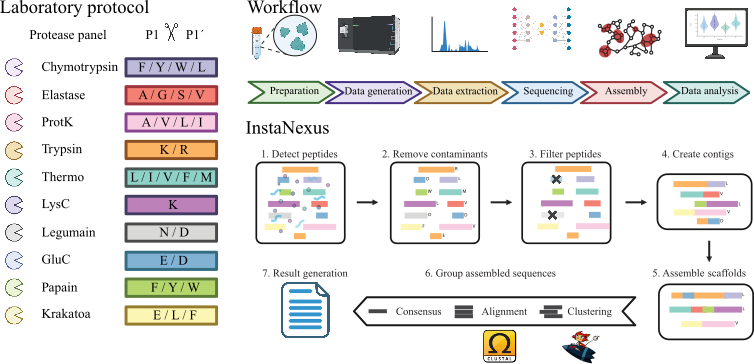
InstaNexus is a generalizable, end-to-end workflow for direct protein sequencing, tailored to reconstruct full-length protein therapeutics such as antibodies and nanobodies. It integrates AI-driven de novo peptide sequencing with optimized assembly and scoring strategies to maximize accuracy, coverage, and functional relevance.
This pipeline enables robust reconstruction of critical protein regions, advancing applications in therapeutic discovery, immune profiling, and protein engineering.
- 🧬 Supports De Bruijn Graph and Greedy-based assembly
- ⚗️ Handles multiple protease digestions (Trypsin, LysC, GluC, etc.)
- 🧹 Integrated contaminant removal and confidence filtering
- 🧩 Clustering, alignment, and consensus sequence reconstruction
- 🎛️ Parallel hyperparameter optimization via the
instanexus-optimizegrid-search CLI - 🔗 Integrates with external tools:
- MMseqs2 for fast clustering
- Clustal Omega for high-quality alignment
- 📦 Reproducible environments via uv or conda
- 📊 Output-ready for downstream analysis and visualization
| Folder / File | Description |
|---|---|
docs/ |
Sphinx documentation, tutorials, and images |
fasta/ |
FASTA reference and contaminant sequences |
inputs/ |
Example input CSV files |
json/ |
Metadata and parameter configuration files |
outputs/ |
Generated results (created during execution) |
src/instanexus/ |
Core InstaNexus package |
src/instanexus/main.py |
Runs the full pipeline |
src/instanexus/preprocessing.py |
Module for data cleaning |
src/instanexus/assembly.py |
Module for sequence assembly |
src/instanexus/clustering.py |
Module for clustering (mmseqs2) |
src/instanexus/alignment.py |
Module for alignment (clustalo) |
src/instanexus/consensus.py |
Module for consensus generation |
src/instanexus/optimize.py |
Entry point for the instanexus-optimize CLI |
scripts/optimization/ |
Grid-search and optimization workflows |
tests/ |
Pytest unit and integration tests |
pyproject.toml |
Package metadata, dependencies, and entry point |
environment.linux.yml |
Conda environment specification (Linux) |
environment.osx-arm64.yaml |
Conda environment specification (macOS, Apple Silicon) |
.pre-commit-config.yaml |
Pre-commit hook configuration |
InstaNexus requires Python 3.10+, MMseqs2, and Clustal Omega. You can manage the environment with either uv or conda (the conda environment files bundle MMseqs2 and Clustal Omega for you).
- uv — fast Python package manager
- conda / mamba — cross-platform package and environment manager
- MMseqs2
- Clustal Omega
pip install instanexusgit clone git@github.com:Multiomics-Analytics-Group/InstaNexus.git
cd InstaNexuscurl -LsSf https://astral.sh/uv/install.sh | shuv sync --all-extras creates a .venv/ and installs the runtime plus all optional
(docs, lint, dev) dependencies from pyproject.toml/uv.lock.
uv sync --all-extrasNote: MMseqs2 and Clustal Omega are not Python packages. With uv, install them separately (e.g. via your system package manager) or use the conda option below, which bundles them.
uv run pre-commit install --hook-type pre-commit --hook-type commit-msguv run instanexus --helpThe conda environment files pin the Python dependencies and the external tools (MMseqs2, Clustal Omega), so they provide a fully self-contained setup.
git clone git@github.com:Multiomics-Analytics-Group/InstaNexus.git
cd InstaNexus
# Linux
conda env create -f environment.linux.yml
# macOS (Apple Silicon)
conda env create -f environment.osx-arm64.yaml
conda activate instanexus
# install InstaNexus itself into the environment
pip install -e .Verify the installation:
instanexus --helpAfter installation (and adding the [project.scripts] entry point), you can run the entire InstaNexus pipeline using the instanexus command.
All parameters for preprocessing, assembly, clustering, and consensus are provided in a single call. The pipeline will automatically create a unique, timestamped output folder for that specific combination of parameters.
instanexus --helpExample: Run the full pipeline This command runs the complete workflow:
Preprocesses the input CSV.
Assembles using dbg (De Bruijn graph).
Clusters the resulting scaffolds.
Aligns the clusters.
Generates consensus sequences.
instanexus \
    --input-csv inputs/bsa.csv \
    --folder-outputs outputs \
    --metadata-json-path json/sample_metadata.json \
    --contaminants-fasta-path fasta/contaminants.fasta \
    --assembly-mode dbg \
    --conf 0.9 \
    --kmer-size 7 \
    --size-threshold 12 \
    --min-overlap 3 \
    --min-seq-id 0.85 \
    --coverage 0.8
The results for this specific run will be saved in a unique directory, such as:outputs/bsa/dbg_c0.9_ks7_mo3_ts12/
InstaNexus ships with a parallel grid-search optimizer, exposed as the instanexus-optimize
command (entry point for scripts/optimization/grid_search.py). It sweeps assembly
parameters across a grid, evaluates each combination against a reference, and ranks them
with a normalized Composite Score combining Coverage, N50, scaffold count, and maximum
contig length (see scripts/optimization/README.md for
the exact formula).
The search space for each assembly mode (greedy, dbg_weighted, multimodal_dbg) is
defined in json/gridsearch_params.json.
instanexus-optimize \
    --input-csv inputs/ma1_cleaned.csv \
    --metadata-json json/sample_metadata.json \
    --grid-json json/gridsearch_params.json \
    --mode dbg_weighted \
    --chain light \
--workers 16| Flag | Description |
|---|---|
--input-csv |
Raw or cleaned input CSV (preprocessing runs automatically if no cleaned file exists in --output-dir) |
--metadata-json |
Path to sample_metadata.json (required for reference protein lookup) |
--grid-json |
Path to gridsearch_params.json defining the parameter grid |
--mode |
Assembly mode (greedy, dbg_weighted, multimodal_dbg) |
--chain |
Chain type for antibodies (light / heavy); omit for single-chain samples |
--workers |
Number of parallel worker processes (default: 8) |
--output-dir |
Directory to save results (default: outputs/_grid_search) |
To sweep multiple samples and modes at once, see scripts/optimization/run_all_gridsearch.sh.
Results can be summarized and visualized with scripts/optimization/analyze_optimization.py.
This project is licensed under the MIT License.
InstaNexus was developed at DTU Biosustain and DTU Bioengineering.
We are grateful to the DTU Bioengineering Proteomics Core Facility for maintenance and operation of mass spectrometry instrumentation.
We also thank the Informatics Platform at DTU Biosustain for their support during the development and optimization of InstaNexus.
Special thanks to the users and developers of:
- Hauser, M., et al. MMseqs2: ultra fast and sensitive sequence searching. Nature Biotechnology 35, 1026–1028 (2016). https://doi.org/10.1038/nbt.3988
- Sievers, F., et al. Fast, scalable generation of high-quality protein multiple sequence alignments using Clustal Omega. Molecular Systems Biology 7, 539 (2011). https://doi.org/10.1038/msb.2011.75
- Eloff, K., Kalogeropoulos, K., Mabona, A., Morell, O., Catzel, R., Rivera-de-Torre, E., ... & Jenkins, T. P. (2025). InstaNovo enables diffusion-powered de novo peptide sequencing in large-scale proteomics experiments. Nature Machine Intelligence, 1-15.
If you find this project useful in your research or work, please cite our publication in Molecular & Cellular Proteomics: Generalizable direct protein sequencing with InstaNexus.
@article{reverenna2026generalizable,
  title={Generalizable direct protein sequencing with InstaNexus},
  author={Reverenna, Marco and Nielsen, Maike Wennekers and Wolff, Darian Stephan and Daniel, Jemma and Lytra, Elpida and
          Thumtecho, Suthimon and Colaianni, Pasquale D and Ljungars, Anne and Laustsen, Andreas H and Schoof, Erwin M and
          Van Goey, Jeroen and Jenkins, Timothy P and Lukassen, Marie V and Santos, Alberto and Kalogeropoulos, Konstantinos},
  journal={Molecular \& Cellular Proteomics},
  volume={25},
  number={4},
  pages={101547},
  year={2026},
  doi={10.1016/j.mcpro.2026.101547},
  publisher={Elsevier}
}