Enveda-180: generation of a large open multimodal MS/MS and ion mobility spectral library for drug-like small molecules




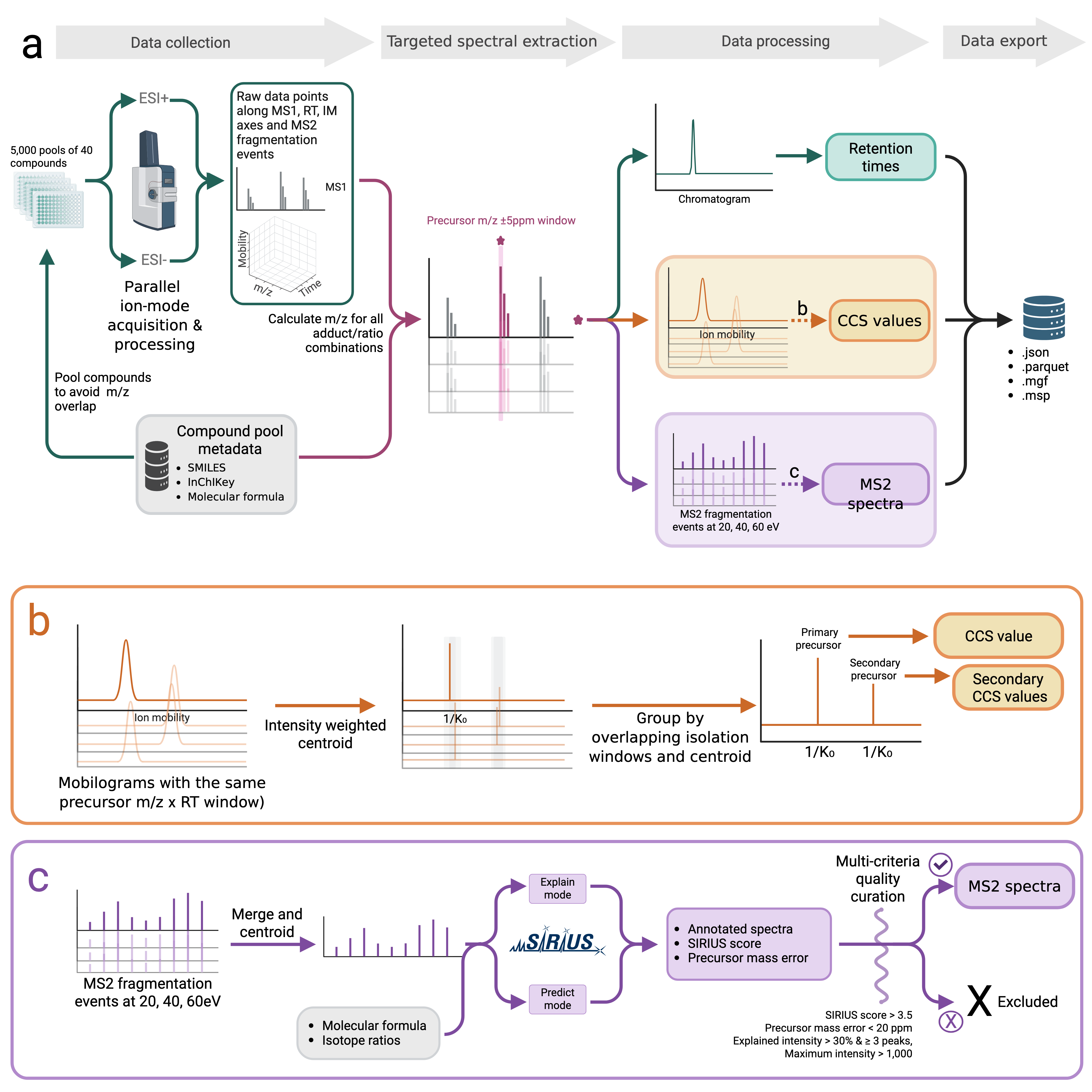
This repository contains the code and notebooks for the Enveda-180 project, which generates a large open multimodal MS/MS + ion mobility spectral library for drug-like small molecules from the Enamine REAL space. The project is a collaboration between Enveda and the scientific community, and we welcome contributions and feedback.
Krettler, C., Kind, T., DeBloois, E., Killian, M., Prince, J., Taylor, J., Gadiya, Y., Simpson, P., Domingo-Fernández, D., Allen, A., Colluru, V., Healey, D. (2026). Enveda-180: generation of a large open multimodal MS/MS and ion mobility spectral library for drug-like small molecules. ChemRxiv. https://doi.org/10.26434/chemrxiv.15004319/v1
enveda-180/
  data_processing/        # Python package: ms_prepper + extraction + curation
  scripts/                # CLI runners (build manifest, run ms_prepper, run pipeline)
  notebooks/              # process.ipynb — papermill-driven pipeline entry point
  tests/                  # Unit tests
  docs/                   # Design / agent notes
  pyproject.toml          # Hatchling build; the package installs as `data_processing`
  README.md, LICENSE
The package lives at data_processing/ and is installed under the import
name data_processing.
uv sync
# or, with pip:
pip install -e .
Python 3.11–3.13 is supported.
The data_processing package has two halves:
data_processing.ms_prepper— read a Bruker.dfolder and write four per-msrun parquets (ms1,ms2,ms2_event,frame).data_processing.{extraction, curation, pipeline}— targeted extraction of MS/MS spectra for each compound-pool member across all common adducts, plus quality-curation helpers.
The default adduct list is surfaced at the package root:
from data_processing import COMMON_ADDUCTS, CATION_ADDUCTSPositive mode: [M+H]+, [M+Na]+, [M+NH4]+, [M+K]+, [2M+Na]+,
[2M+H]+, [M-H2O+H]+, [M-H4O2+H]+
Negative mode: [M-H]-, [M+Cl]-, [M+FA-H]-, [M+Br]-, [M+Hac-H]-,
[2M-H]-, [2M+FA-H]-, [2M+Hac-H]-, [M-H2O-H]-
Cation (natively charged) mode: [M]+
All exact monoisotopic offsets are computed from the adduct name strings via
molmass in data_processing.extraction.load.compute_adduct_metadata. To
add an adduct, append its name to COMMON_ADDUCTS (or CATION_ADDUCTS) in
data_processing/extraction/load.py.
create-signal-tables --input /path/to/sample.d --output-dir /data/enamine_prepor from Python:
from data_processing.ms_prepper import pipeline
pipeline.run(input_path="/path/to/sample.d", output_dir="/data/enamine_prep")
This writes four parquets named {msrun_id}.{ms1,ms2,ms2_event,frame}.parquet.
Set environment variables (a .env file at the repo root is auto-loaded):
ENAMINE_PROCESSING_DATA_PATH=/data/data_processing
ENAMINE_PREP_DATA_PATH=/data/data_processing/input/enamine_prep
ENAMINE_PROCESSING_LOG_LEVEL=INFO
Expected input layout:
${ENAMINE_PROCESSING_DATA_PATH}/
  input/
    enamine_prep/
      {msrun_id}.ms1.parquet
      {msrun_id}.ms2.parquet
      {msrun_id}.ms2_event.parquet
      {msrun_id}.frame.parquet
    preprocessed/
      <my-batch>/
        compound_metadata.parquet
        compound_pool_id_to_msrun_ids_df.parquet
  output/
    <my-batch>/
      <version>/
        extracted/...
        annotated/...
        annotated_matched/...
        final/...
import asyncio
from data_processing import pipeline

asyncio.run(pipeline.run(
    name="my-batch",
    version="v0.1",
    log_path="/tmp/enamine-processing-run",
))
Or call the headline extraction function directly:
from pathlib import Path
from data_processing.pipeline import extract_spectra

spectra = extract_spectra(
    compound_pool_id_to_msrun_ids_df_path=Path(".../compound_pool_id_to_msrun_ids_df.parquet"),
    compound_metadata_df_path=Path(".../compound_metadata.parquet"),
    export_folder=Path(".../output/my-batch/v0.1"),
    version="v0.1",
)scripts/ contains the end-to-end runners used to produce the Enveda-180
library:
# 1. Build a manifest mapping MSB ids -> raw .d filenames for every batch.
#    (Enveda-internal: loads data from Databricks.)
python scripts/build_run_manifest.py --all

# 2. Download the .d folders listed in the manifest to a local directory.
#    (Use whatever tool your environment provides — azcopy, gsutil, rclone, ...)

# 3. Run ms_prepper on every .d folder for one batch.
python scripts/run_ms_prepper.py \
    --batch enamine-part1 \
    --raw-dir /scratch/enamine/raw \
    --output-dir $ENAMINE_PREP_DATA_PATH \
    --skip-existing

# 4. Run the extraction + curation pipeline.
python scripts/run_pipeline.py --batch enamine-part1 --version v0.1
External users without Enveda Databricks access should skip step 1 and
hand-author raw_file_manifest.parquet with at least the columns
msrun_id, raw_file.
notebooks/process.ipynb is the canonical
papermill-driven entry point for running the extraction + curation
pipeline against one preprocessed batch. It is the notebook-flavoured
equivalent of scripts/run_pipeline.py — pick whichever you prefer.
name="my-batch"
version=$(date +%b-%d-%Y)
folder_path="$ENAMINE_PROCESSING_DATA_PATH/logs/${name}"
log_path="${folder_path}/${version}"
mkdir -p "$folder_path"

papermill notebooks/process.ipynb "${log_path}.ipynb" \
    -p name "$name" \
    -p version "$version" \
-p log_path "$log_path"Every tunable knob is exposed in data_processing.config and re-exported
from the package root:
| Name | Source | Description |
|---|---|---|
COMMON_ADDUCTS |
extraction.load |
Adducts searched per compound. |
CATION_ADDUCTS |
extraction.load |
Adducts for natively charged species. |
DATA_PATH |
extraction.constants |
Root data directory ($ENAMINE_PROCESSING_DATA_PATH). |
ENAMINE_PREP_DATA_PATH |
extraction.constants |
ms_prepper parquet directory. |
ENAMINE_PREP_VERSION |
extraction.constants |
Stamped on every extracted spectrum. |
INDEX_COLUMNS |
curation.constants |
["msrun_id", "msms_aggregate_id"]. |
HASH_PRECISION |
curation.constants |
Spectrum-hash mz rounding (default 1). |
TOP_N, TOLERANCE_DA |
curation.constants |
Library-match knobs. |
EXPORT_KEYS, DS8_EXPORT_KEYS |
curation.constants |
Columns written to disk. |
SIRIUS annotation is not invoked automatically. Run SIRIUS yourself
(https://bio.informatik.uni-jena.de/software/sirius/) on the extracted
jsonl output and merge the resulting columns into the dataframe before
continuing. All downstream curation code reads SIRIUS columns defensively, so
the pipeline still completes without them.
MIT. See LICENSE.