







Security scanner for AI infrastructure and supply chain.
Discover → Scan → Analyze → Enforce — AI BOM generation, CVEs, blast radius, runtime proxy, 11 compliance frameworks.
pip install agent-bom        # install
agent-bom scan               # auto-discover MCP configs + scan
agent-bom scan --enrich      # + NVD CVSS + EPSS + CISA KEV enrichment
That's it. agent-bom discovers your MCP client configs (Claude Desktop, Cursor, Windsurf, and 20 more), resolves every server's dependencies, checks them against OSV/NVD/GHSA, and maps the blast radius — which agents, credentials, and tools are affected by each vulnerability.

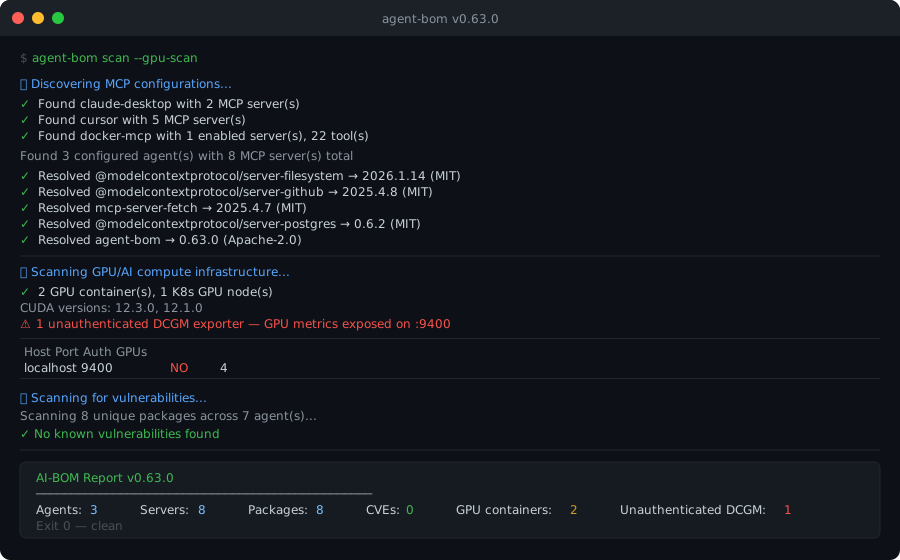
Traditional scanners tell you a package has a CVE. agent-bom tells you which AI agents are compromised, which credentials leak, which tools an attacker reaches — and then blocks it in real time.
Four capabilities, one tool:
- Scan — discover AI agents, MCP servers, cloud services, model files, GPU resources. Generate an AI BOM. Check every dependency against OSV + NVD + GHSA + EPSS + CISA KEV.
- Analyze — blast radius mapping (CVE → package → server → agent → credentials → tools), credential exposure, posture scoring, 11-framework compliance
- Enforce — runtime MCP proxy with 7 behavioral detectors (rug pull, injection, credential leak, exfil, cloaking, rate limiting, vector DB injection), policy-as-code
- Trust — audit CLAUDE.md, .cursorrules, AGENTS.md, SKILL.md for malicious patterns, typosquatting, and Sigstore provenance
Read-only. Agentless. Open source.
CVE-2025-1234  (CRITICAL . CVSS 9.8 . CISA KEV)
  |-- better-sqlite3@9.0.0  (npm)
       |-- sqlite-mcp  (MCP Server . unverified . root)
            |-- Cursor IDE  (Agent . 4 servers . 12 tools)
            |-- ANTHROPIC_KEY, DB_URL, AWS_SECRET  (Credentials exposed)
            |-- query_db, read_file, write_file, run_shell  (Tools at risk)

 Fix: upgrade better-sqlite3 -> 11.7.0

32 tools available to any MCP-compatible AI assistant.
pip install 'agent-bom[mcp-server]'
agent-bom mcp-server
Add to your MCP client config (Claude Desktop, Cursor, etc.):
{
  "mcpServers": {
    "agent-bom": {
      "command": "agent-bom",
      "args": ["mcp-server"]
    }
  }
}
Also available on Glama, Smithery, MCP Registry, and OpenClaw.
docker run --rm -v ~/.config:/root/.config:ro agentbom/agent-bom scan
docker run --rm agentbom/agent-bom scan --image nginx:latest
docker run --rm agentbom/agent-bom mcp-server # MCP server modeAI agents run on instruction files — CLAUDE.md, .cursorrules, AGENTS.md, SKILL.md. A malicious or compromised instruction file is a supply chain attack that executes with full agent permissions. agent-bom audits every instruction file it finds.
agent-bom scan --skill-only

CLAUDE.md  →  SUSPICIOUS (high confidence)
  [CRITICAL] Credential/secret file access
             "cat ~/.aws/credentials" detected — reads secret files
  [HIGH]     Safety confirmation bypass
             "--dangerously-skip-permissions" found — disables all guardrails
  [HIGH]     Typosquatting risk: server name "filessystem" (→ filesystem)
  [MEDIUM]   External URL in instructions: https://malicious-cdn.com/hook.js

  Trust categories
    Purpose & Capability  WARN  — description vs. actual tool mismatch
    Instruction Scope     FAIL  — file reads outside home directory
    Install Mechanism     FAIL  — unverified install source, no Sigstore sig
    Credentials           WARN  — 3 env vars undocumented
    Persistence/Privilege PASS  — no persistence, no privilege escalation
Five trust categories, 17 behavioral risk patterns, Sigstore signature verification. No network calls — fully local static analysis.
- Discover -- auto-detect MCP configs, Docker images, K8s pods, cloud resources, model files
- Scan -- send package names + versions to public APIs (OSV.dev, NVD, EPSS, CISA KEV). No secrets leave your machine.
- Analyze -- blast radius mapping, tool poisoning detection, compliance tagging, posture scoring
- Track -- persistent asset database records first_seen, last_seen, resolved status, and MTTR per vulnerability across scans
- Report -- 16 output formats: JSON, SARIF, CycloneDX 1.6, SPDX 3.0, HTML, JUnit XML, CSV, Markdown, Mermaid, SVG, Prometheus, and more. Alert dispatch to Slack/webhooks.

Read-only guarantee. Never writes configs, never runs servers, never stores secrets. --dry-run previews everything. Every release is Sigstore-signed.
Scanning options
agent-bom scan                                     # auto-discover + scan
agent-bom scan --enrich                            # + NVD CVSS + EPSS + CISA KEV
agent-bom scan -f html -o report.html              # HTML dashboard
agent-bom scan --enforce                           # tool poisoning detection
agent-bom scan --fail-on-severity high -q          # CI gate
agent-bom scan --ignore-file .agent-bom-ignore.yaml  # suppress known false positives
agent-bom scan --image myapp:latest                # Docker image scanning
agent-bom scan --k8s --all-namespaces              # K8s image scanning (cluster-wide)
agent-bom scan --k8s-mcp                           # Discover MCP pods + CRDs in Kubernetes
agent-bom scan --include-processes                 # Scan running host MCP processes (psutil)
agent-bom scan --include-containers                # Scan Docker containers for MCP servers
agent-bom scan --health-check                      # Probe discovered servers for liveness
agent-bom scan --siem splunk --siem-url https://...  # Push findings to SIEM
agent-bom scan --aws --snowflake --databricks      # Multi-cloud
agent-bom scan --hf-model meta-llama/Llama-3.1-8B  # model provenance
agent-bom scan --vector-db-scan                    # Scan self-hosted + Pinecone cloud vector DBs
agent-bom scan --gpu-scan                          # Discover GPU containers + K8s nodes, detect unauthenticated DCGM exporters
agent-bom scan --browser-extensions               # Scan Chrome/Edge/Firefox extensions for dangerous permissions
agent-bom scan --skill-only                       # Audit AI instruction files (CLAUDE.md, .cursorrules, AGENTS.md)
agent-bom scan --save report.json                  # Save + track assets (first_seen, resolved, MTTR)
agent-bom graph report.json --format dot           # Export dependency graph (DOT/Mermaid/JSON)
agent-bom proxy-configure --apply                  # Auto-wrap MCP configs with security proxy
Runtime enforcement
Sit between your MCP client and server, enforce policy in real time:
# Wrap a single server — intercept every tool call
agent-bom proxy --command "uvx mcp-server-filesystem /" --policy policy.yml

# Protect mode — run standalone detector engine
agent-bom protect --mode http

# Watch MCP configs for drift — alert on changes
agent-bom watch --webhook https://hooks.slack.com/...

# Introspect a live MCP server — list tools, detect drift
agent-bom introspect --command "uvx mcp-server-filesystem /"
agent-bom introspect --all                                         # auto-discover all configured servers
agent-bom introspect --all --baseline baseline.json               # exit 1 on new/removed tools

# Policy file — 17 conditions, zero code required
# policy.yml:
#   blocked_tools: [run_shell, exec_command]
#   require_agent_identity: true
#   rate_limit: {threshold: 50, window_seconds: 60}
Auto-discovers 22 MCP client types: Claude Desktop, Claude Code, Cursor, Windsurf, Cline, VS Code Copilot, Continue, Zed, Cortex Code, Codex CLI, Gemini CLI, Goose, Snowflake CLI, OpenClaw, Roo Code, Amazon Q, ToolHive, Docker MCP Toolkit, JetBrains AI, Junie, Copilot CLI, Tabnine, and custom paths.

Capability comparison
| Capability | Trivy / Grype | AI BOM tools | agent-bom |
|---|---|---|---|
| CVE vulnerability scanning | Yes | No | Yes (OSV + NVD + EPSS + CISA KEV + GHSA) |
| SBOM generation | CycloneDX, SPDX | CycloneDX | CycloneDX 1.6, SPDX 3.0, SARIF |
| OS / system package scanning | Yes | No | Via Docker image scan (Grype/Syft) |
| AI agent discovery | No | Partial | 22 MCP client types + Docker + K8s + processes |
| GPU/ML package scanning | No | No | NVIDIA CSAF + CUDA/cuDNN/PyTorch/TF/JAX/vLLM |
| Blast radius mapping | No | No | CVE → package → server → agent → credentials → tools |
| Credential exposure analysis | No | No | Which secrets leak per vulnerability, per agent |
| Runtime proxy / enforcement | No | No | 7 behavioral detectors, policy-as-code, per-tool rate limiting |
| Instruction file trust | No | No | CLAUDE.md/.cursorrules — 17 patterns, typosquat, Sigstore |
| Compliance frameworks | No | No | 11 frameworks (OWASP, MITRE, NIST, EU AI Act, CIS, SOC 2) |
| Cloud AI inventory | No | Partial | 12 providers (AWS, Azure, GCP, Snowflake, Databricks, ...) |
| Model file scanning | No | Extension-based | 13 formats + SHA-256 + provenance + pickle risk |
| MCP server registry | No | No | 427+ servers with risk levels and tool inventories |
| Policy-as-code + CI gate | No | Partial | 17 conditions, severity gates, Jira auto-create |
| Output formats | JSON, SARIF | JSON, CycloneDX | 16 formats (JSON, SARIF, HTML, JUnit, CSV, Markdown, ...) |
| SIEM integration | No | No | Splunk HEC, Datadog, Elasticsearch (raw + OCSF) |
| Lateral movement analysis | No | No | Agent context graph, shared credentials, BFS attack paths |
| Asset tracking / MTTR | No | No | SQLite DB — first_seen/resolved/reopened, scan-over-scan diff |
What it scans — full coverage
| Capability | Details |
|---|---|
| AI agent discovery | 22 MCP client types + Docker Compose + running processes + containers + K8s pods/CRDs |
| GPU/ML package scanning | NVIDIA CSAF advisories for CUDA, cuDNN, PyTorch, TensorFlow, JAX, vLLM + AMD ROCm via OSV |
| AI supply chain | Model provenance (pickle risk, digest, gating), HuggingFace Hub, Ollama, MLflow, W&B |
| AI cloud inventory | Coreweave, Nebius, Snowflake, Databricks, OpenAI, HuggingFace Hub — config discovery + CVE tagging |
| Blast radius mapping | CVE → package → server → agent → credentials → tools |
| Credential exposure | Which secrets leak per vulnerability, per agent |
| Tool poisoning detection | Description injection, capability combos, drift detection |
| Privilege detection | root, shell access, privileged containers, per-tool permissions |
| 11-framework compliance | OWASP LLM + MCP + Agentic + AISVS v1.0, MITRE ATLAS, NIST AI RMF + CSF, EU AI Act, SOC 2, ISO 27001, CIS |
| MITRE ATT&CK mapping | Dynamic technique lookup by tactic phase (no hardcoded T-codes) |
| Posture scorecard | Letter grade (A-F), 6 dimensions, incident correlation (P1-P4) |
| Policy-as-code + Jira | 17 conditions, CI gate, auto-create Jira tickets for violations |
| SIEM push | Splunk HEC, Datadog Logs, Elasticsearch — raw or OCSF format |
| Server health checks | Lightweight liveness probe — reachable, tool count, latency, protocol |
| Lateral movement analysis | Agent context graph, shared credentials, BFS attack paths |
| 427+ server MCP registry | Risk levels, tool inventories, auto-synced weekly |
| Cloud vector DB scanning | Pinecone index inventory, risk flags, replica counts via API key |
| Dependency graph export | DOT, Mermaid, JSON — agent → server → package → CVE graph |
| OIDC/SSO authentication | JWT verification (Okta, Google, Azure AD, Auth0) for REST API |
| Instruction file trust | SKILL.md/CLAUDE.md/.cursorrules — 17 behavioral patterns, typosquat detection, Sigstore provenance verification |
| Browser extension scanning | Chrome/Edge/Firefox manifest.json — nativeMessaging, dangerous permissions, AI assistant domain access |
| Persistent asset tracking | SQLite DB — first_seen/last_seen/resolved/reopened per vulnerability, MTTR calculation, scan-over-scan diff |
What it scans
| Source | How |
|---|---|
| MCP configs | Auto-discover (22 clients + Docker Compose) |
| Docker images | Grype / Syft / Docker CLI fallback |
| Kubernetes | kubectl across namespaces |
| Cloud providers | AWS, Azure, GCP, Databricks, Snowflake, Coreweave, Nebius |
| AI cloud services | OpenAI, HuggingFace Hub, W&B, MLflow, Ollama |
| GPU/ML packages | PyTorch, TF, JAX, vLLM, CUDA toolkit, cuDNN, TensorRT, ROCm |
| Terraform / GitHub Actions | AI resources + env vars |
| Jupyter notebooks | AI library imports + model refs |
| Model files | 13 formats (.gguf, .safetensors, .pkl, ...) |
| Skill files | CLAUDE.md, .cursorrules, AGENTS.md — behavioral audit, typosquat detection, Sigstore trust verification |
| Browser extensions | Chrome, Brave, Edge, Firefox — dangerous permission detection (nativeMessaging, cookies, AI host access) |
| Existing SBOMs | CycloneDX / SPDX import |
What it outputs — 16 formats
| Format | Flag | Use case |
|---|---|---|
| Console (default) | — | Rich terminal output with color-coded severity |
| Console (verbose) | --verbose |
Full output: agent tree, severity chart, attack flow, frameworks |
| JSON | -f json |
Programmatic consumption, dashboards |
| HTML | -f html |
Shareable interactive dashboard — no server required |
| SARIF 2.1.0 | -f sarif |
GitHub Code Scanning inline annotations |
| CycloneDX 1.6 | -f cyclonedx |
Industry-standard SBOM, OWASP Dependency-Track |
| SPDX 3.0 | -f spdx |
SPDX-compatible AI BOM with AI extensions |
| JUnit XML | -f junit |
CI/CD integration (Jenkins, GitLab CI, Azure DevOps) |
| CSV | -f csv |
Spreadsheet import, SIEM ingestion |
| Markdown | -f markdown |
PR comments, wiki pages, issue bodies |
| Mermaid | -f mermaid |
Supply chain / attack flow / lifecycle diagrams |
| SVG | -f svg |
Embeddable vector diagrams |
| Graph JSON | -f graph |
Cytoscape.js-compatible element list |
| Graph HTML | -f graph-html |
Interactive graph viewer — open in browser |
| Prometheus | -f prometheus |
Metrics scraping, Pushgateway, OTLP export |
| Badge | -f badge |
Shields.io endpoint JSON |
agent-bom scan -f cyclonedx -o ai-bom.cdx.json   # CycloneDX 1.6
agent-bom scan -f sarif -o results.sarif           # GitHub Security tab
agent-bom scan -f html -o report.html              # Interactive dashboard
agent-bom scan -f junit -o results.xml             # JUnit for CI/CD
agent-bom scan -f csv -o findings.csv              # Spreadsheet/SIEM
agent-bom scan -f markdown -o report.md            # PR comments
agent-bom scan -o -                                # Pipe any format to stdout

| Mode | Command | Best for |
|---|---|---|
| CLI | agent-bom scan |
Local audit |
| GitHub Action | `uses: msaad00/agent-bom@v0.70.7 | CI/CD + SARIF |
| Docker | docker run agentbom/agent-bom scan |
Isolated scans (linux/amd64, linux/arm64) |
| REST API | agent-bom api |
Dashboards, SIEM |
| MCP Server | agent-bom mcp-server (32 tools) |
Inside any MCP client |
| Dashboard | agent-bom serve · Full deploy guide |
API + Next.js UI (15 pages) · Postgres/Supabase |
| Runtime proxy | agent-bom proxy |
Intercept + enforce MCP traffic in real time |
| Protect engine | agent-bom protect |
7 behavioral detectors (rug pull, injection, credential leak, exfil sequences, response cloaking, rate limiting, vector DB injection) |
| Config watcher | agent-bom watch |
Filesystem watch on MCP configs, alert on drift |
| Pre-install guard | agent-bom guard pip install <pkg> |
Block vulnerable installs |
| Snowflake | DEPLOYMENT.md | Snowpark + SiS |
Install extras
| Mode | Command |
|---|---|
| Core CLI | pip install agent-bom |
| Cloud (all) | pip install 'agent-bom[cloud]' |
| REST API | pip install 'agent-bom[api]' |
| MCP server | pip install 'agent-bom[mcp-server]' |
| OIDC/SSO auth | pip install 'agent-bom[oidc]' |
| Dashboard | pip install 'agent-bom[ui]' |
| Docker | docker run --rm -v ~/.config:/root/.config:ro agentbom/agent-bom scan |
GitHub Action
- uses: msaad00/agent-bom@v0.70.7
  with:
    severity-threshold: high
    upload-sarif: true
    enrich: true
    fail-on-kev: true
REST API
pip install agent-bom[api]
agent-bom api --api-key $SECRET --rate-limit 30 # http://127.0.0.1:8422/docs| Endpoint | Description |
|---|---|
POST /v1/scan |
Start async scan |
GET /v1/scan/{id} |
Results + status |
GET /v1/scan/{id}/attack-flow |
Per-CVE blast radius graph |
GET /v1/registry |
427+ server registry |
GET /v1/compliance |
Full 11-framework compliance posture |
GET /v1/posture |
Enterprise posture scorecard (A-F) |
GET /v1/posture/credentials |
Credential risk ranking |
GET /v1/posture/incidents |
Incident correlation (P1-P4) |
POST /v1/traces |
OpenTelemetry trace ingestion |
GET /v1/scan/{id}/context-graph |
Lateral movement paths |
GET /v1/malicious/check |
Malicious package check |
GET /v1/proxy/status |
Live proxy metrics (tool calls, blocked, latency p95) |
GET /v1/proxy/alerts |
Runtime behavioral alerts from audit log |
GET /v1/audit |
Query JSONL audit trail (HMAC integrity verified) |
WS /ws/proxy/metrics |
Live metrics push every second (tool_calls, blocked, latency_p95) |
GET /v1/assets |
Persistent vulnerability asset inventory (first_seen, resolved, MTTR) |
GET /v1/assets/stats |
Aggregate asset statistics — open/resolved/critical counts |
WS /ws/proxy/alerts |
Real-time alert stream — new alerts arrive as they happen |
Pre-install guard
Scan packages against OSV and NVD before they are installed. Blocks installs when critical/high CVEs are found.
agent-bom guard pip install requests flask   # scan then install
agent-bom guard npm install express          # same for npm

# Shell alias — intercept every install automatically
alias pip='agent-bom guard pip'
alias npm='agent-bom guard npm'
Options:
--min-severity— minimum severity to block (critical,high,medium; default:high)--allow-risky— warn but proceed instead of blocking
Cloud providers
| Provider | Depth | Install |
|---|---|---|
| Snowflake | Deep (Cortex, MCP, governance, observability) | pip install 'agent-bom[snowflake]' |
| AWS | Standard (Bedrock, Lambda, EKS, ECS, SageMaker) | pip install 'agent-bom[aws]' |
| Azure | Standard (OpenAI, Functions, AI Foundry, Container Apps) | pip install 'agent-bom[azure]' |
| GCP | Standard (Vertex AI, Cloud Functions, GKE, Cloud Run) | pip install 'agent-bom[gcp]' |
| Databricks | Preview (Cluster packages, model serving) | pip install 'agent-bom[databricks]' |
| Nebius | Preview (Managed K8s, containers) | pip install 'agent-bom[nebius]' |
| CoreWeave | Via K8s | --k8s --context=coreweave-cluster |
Docker platform support
Docker images are published for linux/amd64 and linux/arm64. Both architectures are validated in CI on every PR.
| Platform | Method | Notes |
|---|---|---|
| Linux x64 / arm64 | Docker | Native support |
| macOS (Intel / Apple Silicon) | Docker Desktop | Runs Linux containers via virtualization |
| Windows x64 | Docker Desktop (WSL 2) | Runs Linux containers; mount %APPDATA% paths for MCP config discovery |
| Windows Server | Python CLI | pip install agent-bom -- no Docker Desktop required |
Windows-specific volume mount examples and GPU scanning notes: docs/WINDOWS_CONTAINERS.md
Upgrade / Uninstall
pip install --upgrade agent-bom          # upgrade
pip uninstall agent-bom                  # uninstall
rm -rf ~/.agent-bom # remove local data| Platform | Link |
|---|---|
| PyPI | pip install agent-bom |
| Docker | docker run agentbom/agent-bom scan |
| GitHub Action | `uses: msaad00/agent-bom@v0.70.7 |
| Glama | glama.ai/mcp/servers/@msaad00/agent-bom |
| MCP Registry | server.json |
| ToolHive | registry entry |
| OpenClaw | SKILL.md |
| Smithery | smithery.yaml |
| Railway | Dockerfile.sse |

Engine internals

See docs/ARCHITECTURE.md for full diagrams: data flow pipeline, blast radius propagation, compliance framework mapping, integration architecture, and deployment topology.
New to MCP security? docs/MCP_SECURITY_MODEL.md explains the MCP ecosystem, where attacks happen (supply chain, tool poisoning, rug pull, credential exfil, instruction file compromise), and exactly how agent-bom's scanner, proxy, and MCP server each address them.
- Read-only -- never writes configs, runs servers, provisions resources, or stores secrets
- Credential redaction -- only env var names in reports; values never read or logged
- No shell injection -- subprocess uses
asyncio.create_subprocess_exec; command + args validated before every spawn - No SSRF -- all outbound URLs hardcoded or validated; DNS rebinding defense blocks private/loopback/cloud-metadata ranges
- No path traversal --
validate_path(restrict_to_home=True)on all user-supplied paths; MCP tool inputs sanitized - No SQL injection -- all database queries use parameterized statements
- Proxy size guard -- messages >10 MB dropped before parsing; protects against DoS
- Audit integrity -- JSONL audit logs stored at
0600, HMAC-signed (SHA-256). SetAGENT_BOM_AUDIT_HMAC_KEYin production for cross-restart verifiability. - API security -- scrypt KDF for API keys, RBAC (admin/analyst/viewer), OIDC/JWT (RS256/ES256,
nonealgorithm rejected), constant-time comparison --dry-run-- preview every file and API URL before access- Sigstore signed -- releases v0.7.0+ signed via cosign OIDC
- OpenSSF Scorecard -- automated supply chain scoring
- OpenSSF Best Practices -- passing badge (100%) — 67/67 criteria
- Continuous fuzzing -- ClusterFuzzLite fuzzes SBOM parsers, policy evaluator, and skill parser
- PERMISSIONS.md -- full auditable trust contract
Roadmap
GPU / AI compute
- GPU container discovery (Docker — NVIDIA images, CUDA labels,
--gpusruntime) - Kubernetes GPU node inventory (nvidia.com/gpu capacity/allocatable, CUDA driver labels)
- Unauthenticated DCGM exporter detection (port 9400 metrics leak)
- Remote Docker host scanning (currently local daemon only)
- NVIDIA GPU CVE feed — CUDA/cuDNN specific advisories beyond OSV
- GPU utilization and memory anomaly detection
AI supply chain
- OSV + GHSA + NVD + EPSS + CISA KEV vulnerability enrichment
- ML model file scanning (.gguf, .safetensors, .onnx) + SHA-256 + Sigstore
- HuggingFace model provenance and dataset card scanning
- Dataset poisoning detection
- Training pipeline scanning (MLflow DAGs, Kubeflow pipelines)
- Model card authenticity verification (beyond hash/sigstore)
Asset tracking / posture
- Persistent SQLite asset database — first_seen, last_seen, resolved, reopened per vulnerability
- MTTR (Mean Time To Remediate) calculation across scans
- Scan-over-scan diff — new, resolved, reopened, unchanged counts
- REST API:
/v1/assets+/v1/assets/statsfor dashboard integration - SLA enforcement — time-to-fix deadlines per severity (critical < 7d, high < 30d)
- Trend analytics — vulnerability count over time, resolution velocity
Agents / MCP
- 22 MCP client config discovery paths, live introspection, tool drift detection
- Runtime proxy with 7 behavioral detectors (rug pull, injection, credential leak, exfil sequences, response cloaking, rate limiting, vector DB injection) + semantic injection scoring
- Semantic injection scoring — weighted 10-signal model, 0.0–1.0 risk score, MEDIUM/HIGH alerts
- Agent memory / vector store content scanning for injected instructions
- LLM API call tracing (which model was called, with what context)
Identity / access
- OIDC/JWT auth for REST API (Okta, Google Workspace, Azure AD, Auth0, GitHub OIDC)
- Agent-level identity — JWT/opaque token in
_meta.agent_identity, tracked on every audit log entry,require_agent_identitypolicy enforcement - MCP server identity attestation — cryptographic proof of server identity at runtime
- Agent-to-agent permission boundary enforcement
Compliance / standards
- 11 frameworks: OWASP LLM, OWASP MCP, OWASP Agentic, OWASP AISVS v1.0, ATLAS, NIST AI RMF, EU AI Act, NIST CSF, ISO 27001, SOC 2, CIS Controls
- CIS AI benchmarks (pending CIS publication)
- License compliance engine (OSS license risk flagging)
- Workflow engine scanning (n8n, Zapier, Make)
Ecosystem coverage
- Maven / Go ecosystem — test coverage thin (PyPI, npm, cargo, pip best covered)
- Windows platform docs + Docker Desktop guidance (WINDOWS_CONTAINERS.md)
- Windows-native container images (nanoserver/servercore)
See the full list of shipped features.
git clone https://github.com/msaad00/agent-bom.git && cd agent-bom
pip install -e ".[dev]"
pytest && ruff check src/
See CONTRIBUTING.md | SECURITY.md | CODE_OF_CONDUCT.md | GOVERNANCE.md | ROADMAP.md | THREAT_MODEL.md
Apache 2.0 -- LICENSE