graph TB
    subgraph "Kubernetes Cluster"
        subgraph "Namespace: test-app"
            User((User)) --> FrontendSVC[Frontend Service<br/>port: 80]
            FrontendSVC --> FrontendPod[Nginx Pod<br/>serves UI + proxy]

            FrontendPod --> BackendSVC[Backend Service<br/>port: 5000]
            BackendSVC --> BackendPod[Flask API Pod<br/>REST endpoints]

            BackendPod --> DBSVC[PostgreSQL Service<br/>port: 5432]
            DBSVC --> DBPod[PostgreSQL Pod<br/>15-alpine]

            DBPod --> PVC[PersistentVolumeClaim<br/>storage for facts]

            subgraph "Kustomize Structure"
                KustomizeBase[Base/ manifests<br/>common to all envs]
                OverlayDev[Overlay: dev/<br/>env-specific patches]
                OverlayProd[Overlay: prod/<br/>resource limits]
            end
        end
    end

    InitContainer[initContainer<br/>waits for DB ready] -.-> BackendPod
    ResourceQuota[ResourceQuota<br/>CPU: 2 cores, Mem: 4Gi] -.-> Namespace
    LimitRange[LimitRange<br/>default req/limit per pod] -.-> Namespace

    style User fill:#e1f5fe,stroke:#01579b
    style FrontendPod fill:#fff3e0,stroke:#e65100
    style BackendPod fill:#fff3e0,stroke:#e65100
    style DBPod fill:#e8f5e9,stroke:#1b5e20
    style PVC fill:#f3e5f5,stroke:#4a148c
    style InitContainer fill:#fff8e1,stroke:#f57f17
    style ResourceQuota fill:#ffebee,stroke:#b71c1c
    style LimitRange fill:#ffebee,stroke:#b71c1c
Goal: Deploy a three‑tier application (PostgreSQL + Flask API + Nginx frontend) using Kustomize, initContainers, resource governance, and declarative YAML. No manual kubectl commands.
| Component | Technology | Purpose |
|---|---|---|
| Database | PostgreSQL 15-alpine | Persistent storage for mystery facts. Uses PVC for data persistence |
| Backend | Flask API (Python) | REST endpoints /api/facts, /api/facts/random, /api/facts (POST). Depends on PostgreSQL via initContainer |
| Frontend | Nginx + static HTML | Serves UI, proxies /api/ to backend-svc:5000 |
| Orchestration | Kustomize (overlays + patches) | Environment‑agnostic YAML composition |
| Governance | ResourceQuota + LimitRange | CPU/memory limits, storage quota |
| Dependency mgmt | initContainer | Waits for PostgreSQL to be ready |
No hardcoded service addresses – Nginx proxies /api to the backend service.
No monolithic Flask – The database, frontend and backend are separate containers, designed with modular Kustomize bases, following microservices best practices.
Resilience via InitContainers - Distributed systems often suffer from "race conditions" where the application tries to connect before the database is ready.
I implemented a ReadinessProbe using pg_isready. This ensures the database is not just only up, but is capable and ready to accept traffic.
Governance and Noisy Neighbour - ResourceQuota and LimitRange was implemented to enforce a "Fair Use" policy by setting default requests and hard limits on CPU/Memory. I ensured that a spike in one tier won't cause a Denial of Service (DOS) for the entire node or other application.
Asciinema Recording
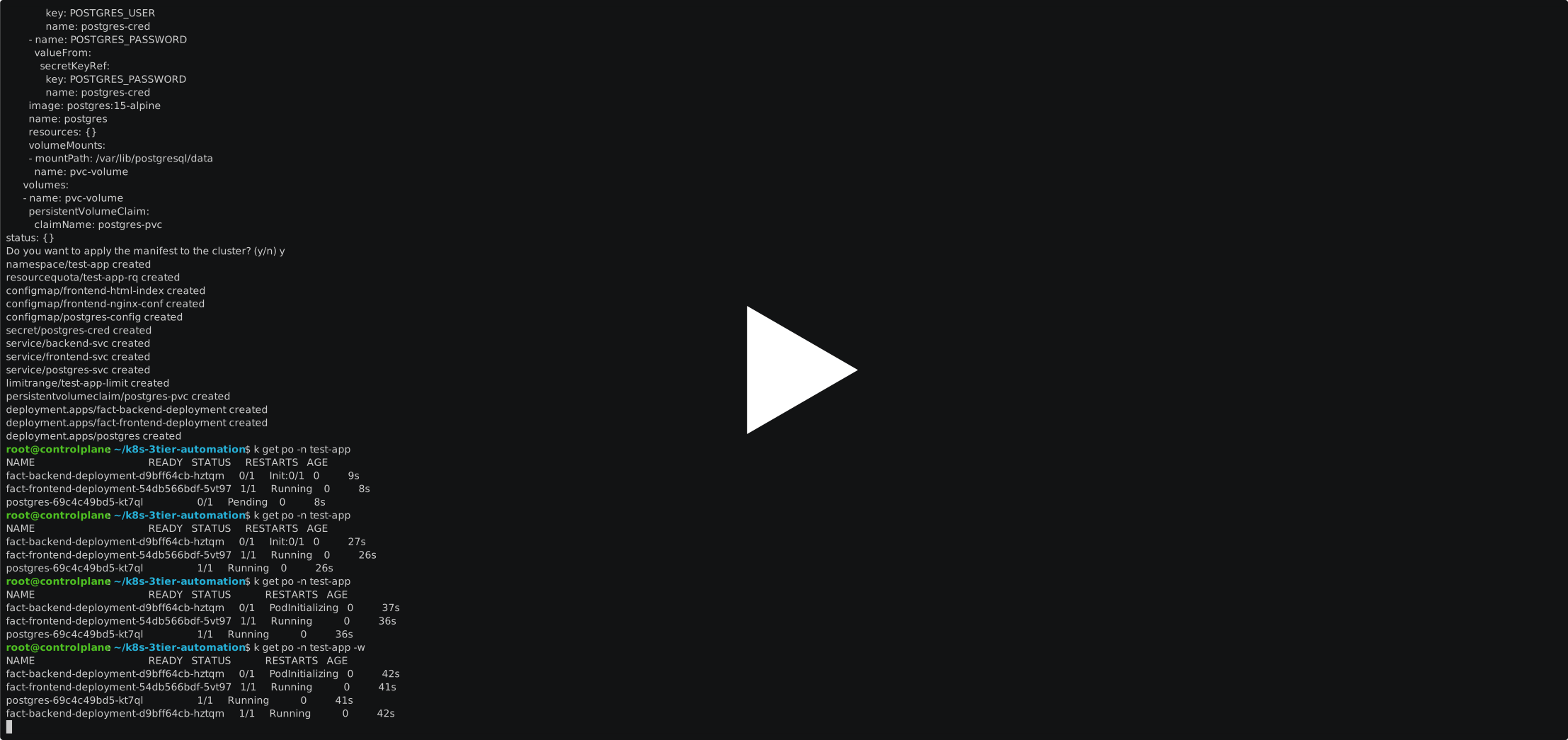
kubectl get all -n test-app

kubectl port-forward svc/frontend-svc 8080:80→ browser showing the Mystery Fact Machine.


- Kubernetes cluster (Minikube, Kind, KillerCoda, or any conformant cluster)
- kubectl (v1.24+)
- kustomize (built into
kubectl 1.14+) - Docker (only if you need to build the backend image – otherwise use the pre‑built
succesc/fact-app:v1)
The script uses
kubectl create --dry-runto generate YAMLs, so no manual editing is required.
-
Clone the repository
git clone https://github.com/susu10-10/k8s-3tier-automation.gitcd k8s-3tier-automation/ -
Place the required files in the same directory as deploy.sh:
index.html(provided above) anddefault.conf(provided above) -
Make the script executable
chmod +x deploy.sh -
Run the script
./deploy.shit will display the kustomized manifest when prompted, type
yto apply to your cluster. -
Verify Deployment
kubectl get all -n test-app(All pods should be
Runningwithin 30-60 seconds) -
Access the frontend
kubectl port-forward -n test-app svc/frontend-svc 8080:80
http://localhost:8080 in your browser.
Add a fact -> it appears. Click "Random Fact" -> a random fact is shown.
| Concept | Where it appears |
|---|---|
| Kustomize | base/ + overlay/ with patches for environment‑specific config |
| initContainer | Backend waits for PostgreSQL TCP port |
| ResourceQuota + LimitRange | CPU (2 cores), memory (4Gi), per‑container defaults (128Mi request, 256Mi limit) |
| Declarative YAML generation | kubectl create --dry-run – no imperative changes |
| ConfigMaps & Secrets | Frontend HTML, Nginx config, PostgreSQL credentials |
| Service discovery | backend-svc:5000 and postgres-svc:5432 (K8s DNS) |
| Volume mounts | PVC for PostgreSQL, ConfigMap mounts for frontend (with subPath) |
Namespace: test-app (PSA label privileged will be hardened in Phase 2)
ResourceQuota:
-
CPU:
2cores (requests + limits) -
Memory:
4Gi
LimitRange:
-
Default request:
100mCPU /128Mimemory -
Default limit:
200mCPU /256Mimemory
This prevents any single pod from hogging the cluster and ensures predictable performance.
Phase 2 will transform this working application into a zero‑trust, least‑privilege environment:
Stay tuned, the same Kustomize structure will be extended with security overlays.
This is a personal learning project to demonstrate CKAD + Sec+ skills. If you find a bug or have a suggestion, please open an issue or a pull request.
MIT – feel free to use this as a template for your own security labs.