









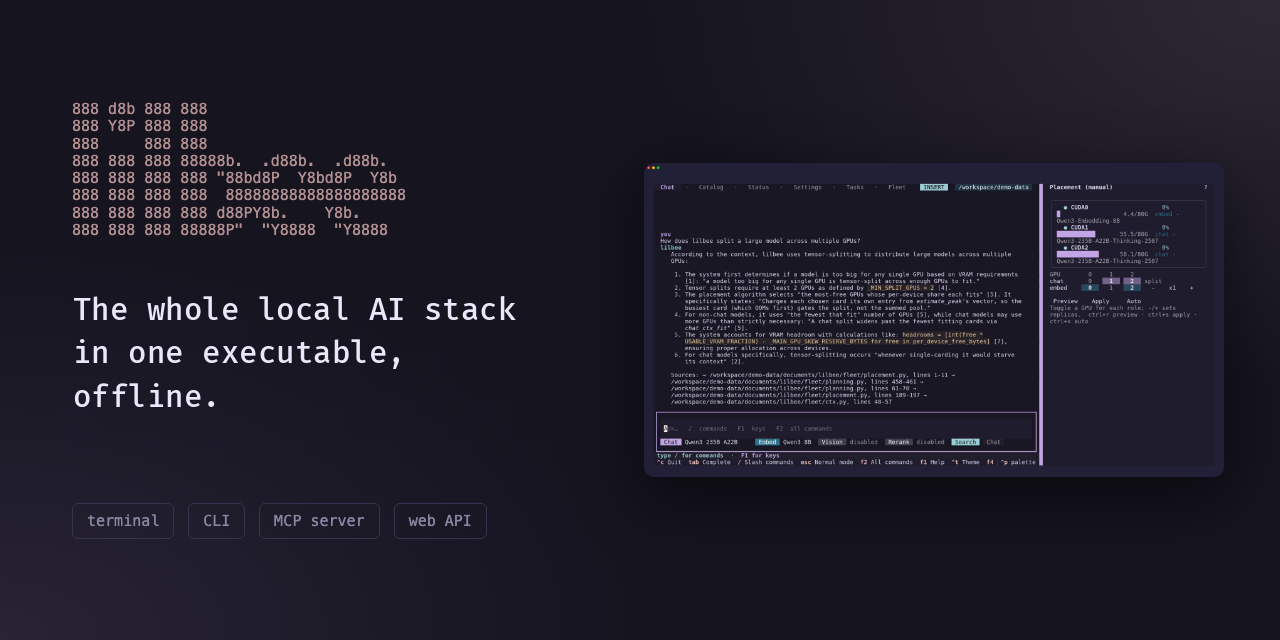
I'm building lilbee, the whole local AI stack in a single executable: it runs and manages the models, and it's a search engine you can talk to. It indexes your files, notes, and code, crawls web pages into your library, and every answer cites the exact file and line. It started as me trying to build an Encarta 99 out of my own stuff that I could talk to privately, and that's still the mission.
Onboarding with local AI is painful. A typical stack is a model server, a vector database, a document ingestion pipeline, a web UI, and a Docker Compose file holding it all together. Every piece needs configuring before you can ask a single question.
lilbee is that whole stack in one self-contained executable: model manager, search engine over your own data, MCP for agents, HTTP for GUIs, and a TUI for the terminal. No containers, no networking, nothing else to install. It scales from one laptop to as many GPUs as you have.


I'm trying to democratize local AI, starting with talking to your own stuff, while building the tool I want for myself.


Terminal-first, because I built it for myself and I knew that if the architecture stayed flexible, friendlier surfaces would come easily. TUI, CLI, REST API, MCP server, and Python library, with multi-GPU placement and integrations for opencode and hermes so programmers can put local AI behind their favorite agents. lilbee is its own model manager: you don't need Ollama or LM Studio at all, and the model families it runs are tested end to end on real GPUs, the architectures behind most of the 190,000+ GGUF models on Hugging Face. Already running Ollama or LM Studio? lilbee connects to them and keeps your models.
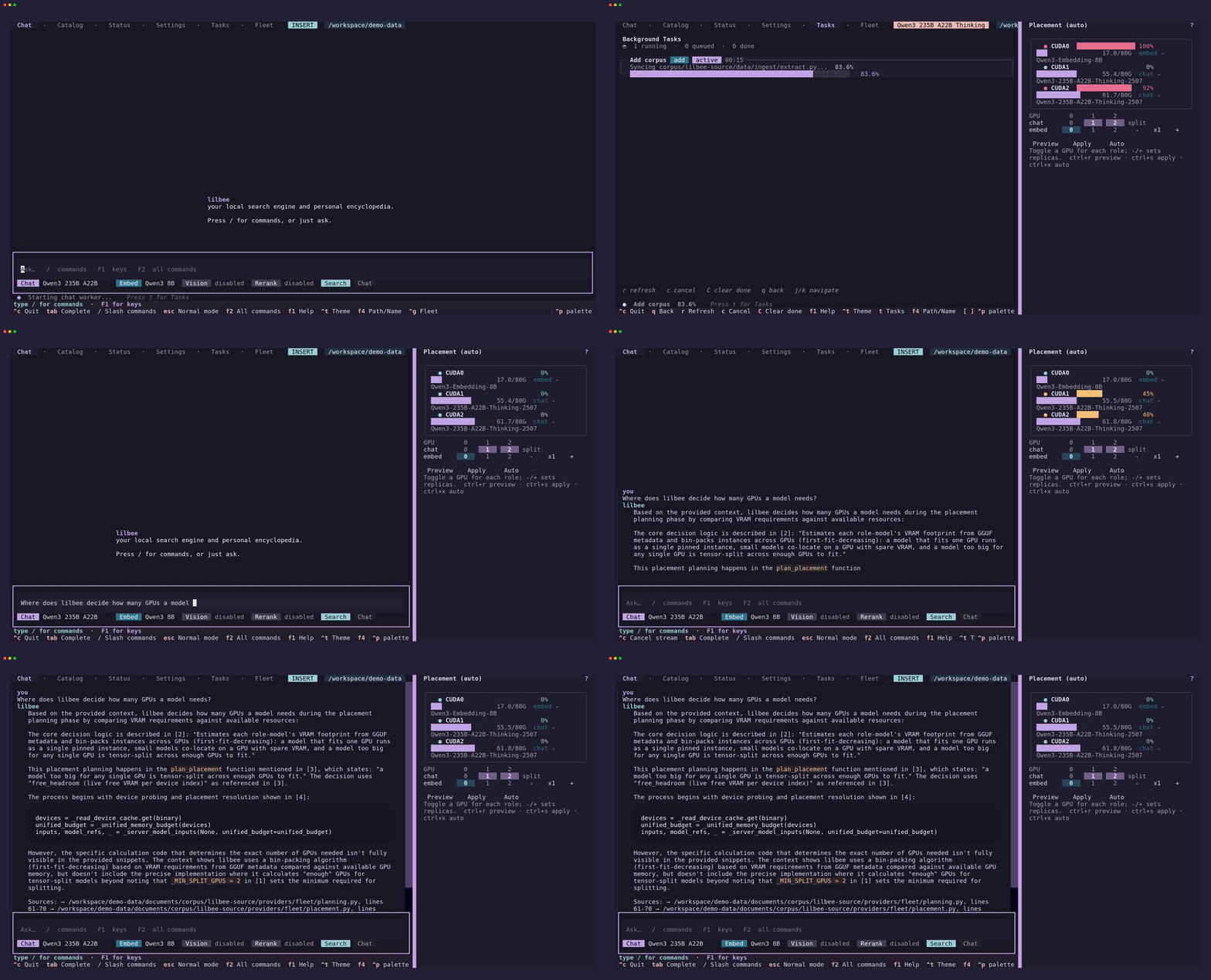


One of those friendlier surfaces, the gateway for Q&A with local models. My favorite story here is a completely non-technical user who went from the plugin store to talking to his solar panel docs in minutes, without ever opening a terminal.
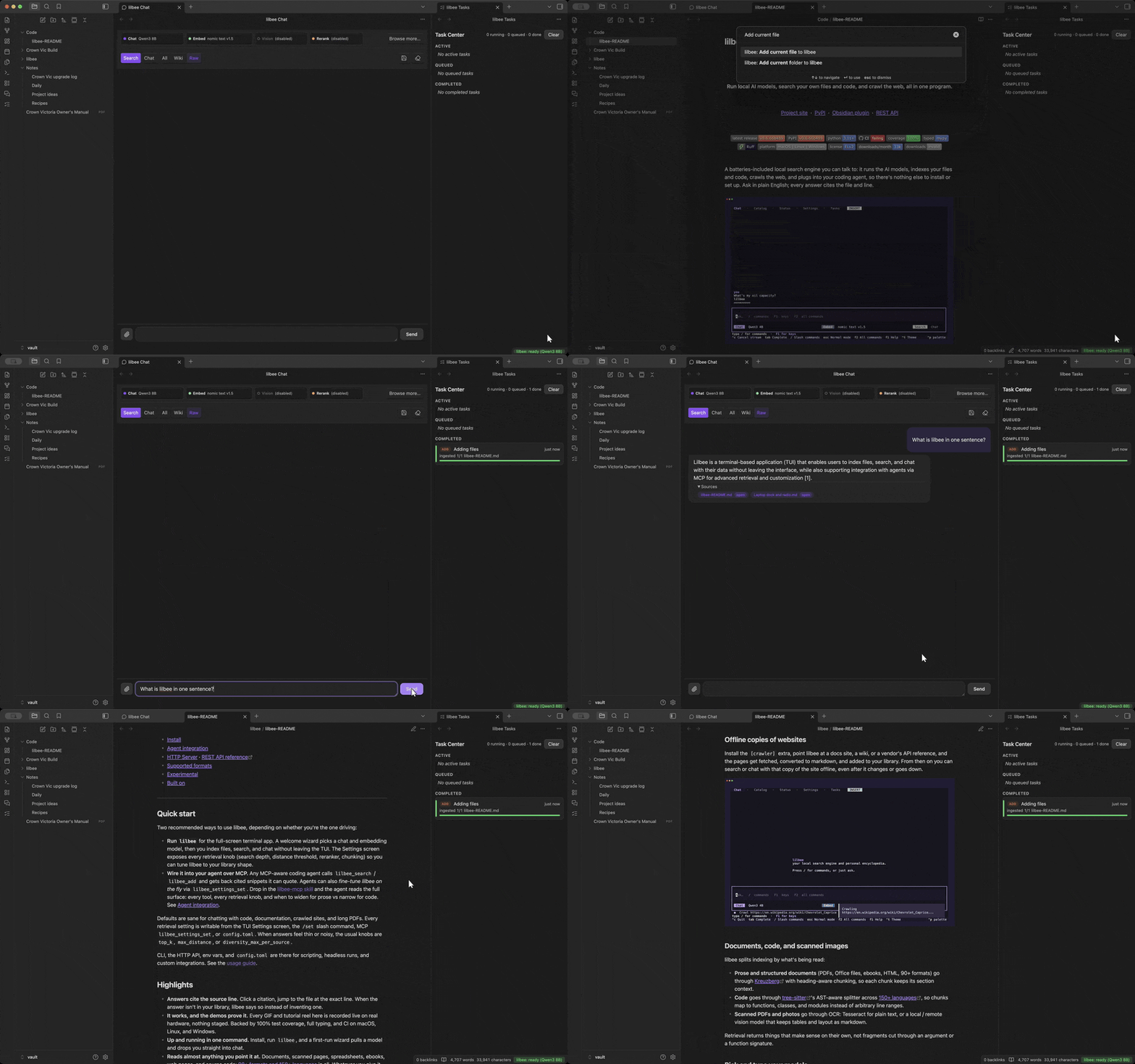
lilbee is built on a lot of open source projects, and the one I work on most is xberg.
Extraction is the core of lilbee. You can't search what you can't read, and an answer is only as good as the text that came out of the document, so a scanned PDF that turns to mush or a table that loses its columns is a bad answer waiting to happen. Good extraction is what makes good search possible. That's why I'm on the xberg team, and where most of my open source work goes.
In early iterations of lilbee I built my own extraction layer. When I found xberg I gutted all of that work, and a lot of it became my earliest contributions there.
Stuff I've contributed that I'm pretty proud of:
| Project | Stars | What I did |
|---|---|---|
xberg / alef  |
  |
Semantic chunking, and better chunking for CSV, XML, YAML and Markdown. A new format: JSONL. PDF page rendering exposed for external vision models. Scanned-PDF detection, so only the pages that need OCR get it. An in-process embedding plugin, and native Intel Mac support. In alef, fixes across the bindings it generates for 16 languages. All my merged PRs. |
lancedb / lance  |
  |
Lance doesn't run on older processors. Two PRs in review to fix that: SIMD dispatch at runtime and compat wheels. |
GPUStack / gguf-parser-go  |
  |
Vision models were being refused on GPUs they actually fit on, because the memory estimate was way too high. Fixed the estimate in the tool GPUStack uses to decide what loads. |
| huggingface_hub / xet-core |
  |
Fixed a crash when a model is downloaded from a program with no terminal attached. Smoother download progress is in review. |
| pdf_oxide |
 |
Fixed text extraction in scientific PDFs: subscripts came out as decimals, fractions fused with the equals sign, words came out in fragments, and rotated pages came out in the wrong order. |
| Project | Stars | What I did |
|---|---|---|
| openapi-generator |  |
Unity support for the C# generator. |
| llama-cpp-python |  |
Some models wouldn't load because of how their chat template was written. |
| mercurius |  |
Fixed a crash in apps with nested loaders. |
| screenshot-glb |  |
Added a timeout so slow renders can finish. |
| MetalAPI |  |
My first project ever, from my last semester of college. Scraped the Metal Archives, the encyclopedic resource for heavy metal, and served the whole thing as a REST API. |
| go-utils |  |
Added unique and fixed reverse in Goldziher's Go library, years before he founded xberg and we ended up working together. |
| simpler-cpp-json |  |
Automatic JSON serialization for any C++ struct, instead of writing the conversion by hand every time. It saved my team a lot of keystrokes. nlohmann/json later shipped the same idea. |
+-+-+-+-+-+-+-+-+-+-+-+-+-+-+-+-+
|t|o|b|i|a|s|@|l|i|l|b|e|e|.|s|h|
+-+-+-+-+-+-+-+-+-+-+-+-+-+-+-+-+


