
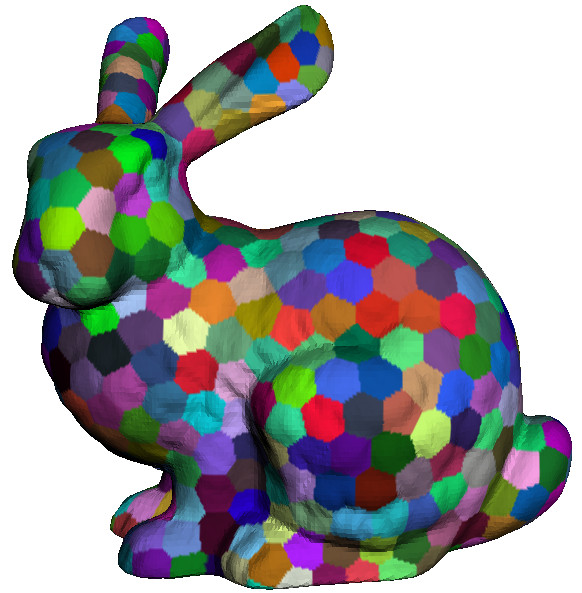
ACVD is a C++ library and executable suite for adaptive coarsening, surface remeshing, and simplification of 3D triangular meshes built on top of VTK (Visualization Toolkit). It implements discrete Centroidal Voronoi Diagram (CVD) algorithms based on publications by Sebastien Valette et al.
-
Agentic Coding Guide: Master reference guide containing repository architecture, C++/VTK memory safety,
$O(1)$ mesh topology mechanics (vtkSurfaceBase), CVD remeshing algorithms, metrics, and CMake build/test instructions. -
vtkSurface API Documentation: Detailed API reference for
vtkSurfaceBaseandvtkSurfaceclasses. -
Other Programs Documentation: Guide for
VolumeAnalysis,ManifoldSimplification, and mesh conversion tools.
The build process generates command-line tools under build/bin/ (or bin/):
ACVD: Sequential isotropic discrete surface remesher.ACVDQ: Quadric-enhanced surface remesher (preserves sharp feature edges, corners, and boundaries).ACVDP: Multi-threaded (OpenMP) parallel version ofACVD.ACVDQP: Multi-threaded (OpenMP) quadric-enhanced parallel version ofACVDQ.AnisotropicRemeshingQ: Anisotropic metric surface remesher with quadric error bounds.AnisotropicRemeshingQP: Multi-threaded version ofAnisotropicRemeshingQ.
- VTK 9.0+ (
libvtk9-devon Debian/Ubuntu) - CMake 3.11+
- C++ Compiler (GCC 7+ or Clang 6+) with C++11 support
- OpenMP (Optional, for multi-threaded executables
ACVDP,ACVDQP,AnisotropicRemeshingQP)
git clone https://github.com/valette/ACVD.git
cd ACVD

# Out-of-source build configuration
cmake -B build -DCMAKE_BUILD_TYPE=Release
cmake --build build -j$(nproc)
Executables will be placed in build/bin/ (or bin/).
./build/bin/ACVD <input_mesh> <n_vertices> <curvature_weight> [options]Required Arguments:
<input_mesh>: Path to input 3D model (.ply,.obj,.vtk,.off,.wrl,.stl).<n_vertices>: Desired number of vertices in output mesh (e.g.3000).<curvature_weight>: Gamma parameter controlling curvature gradation (0.0= uniform density,1.0-2.0= higher density in high-curvature areas).
Options:
-s <ratio>: Subsampling threshold ratio (default:10). Setting-s 100significantly improves output mesh quality.-l <ratio>: Edge splitting ratio (-l 3splits long edges exceeding 3 times the average edge length).-m <0|1>: Enforce 2-manifold output topology (1= enabled,0= disabled).-d <0|1|2>: Interactive visualization level (0= off,1= window on completion,2= step-by-step iteration display). Press key'e'in the display window to advance iterations.-o <directory>: Custom output directory.-of <filename>: Custom output filename (default:simplification.ply).-b <0|1>: Boundary vertex fixing (1= fixed,0= free).-q <0|1|2|3>: Quadric optimization level (default:3).-np <n_threads>: Set number of OpenMP threads for parallel executables (ACVDP,ACVDQP).
./build/bin/ACVDQ <input_mesh> <n_vertices> <curvature_weight> [options]Options: Includes all ACVD options plus:
-q <1|2|3>: Number of quadric matrix eigenvalues used for vertex positioning (default:3).-fv <file>: Text file containing IDs of fixed vertices.-ft <file>: Text file containing IDs of fixed triangles.-np <n_threads>: Set number of threads forACVDQP.
ACVD works by clustering input mesh vertices. Output quality depends on two key parameters:
- Subsampling Ratio (
-s ratio): Controls the ratio of intermediate samples to output vertices. Defaults to10. Increasing to-s 100improves sampling accuracy and output triangle quality. - Edge Splitting Ratio (
-l ratio): Pre-splits input edges longer than ratio X average edge length. Use-l 3to eliminate long, thin triangles in input models. - Manifold Enforcement (
-m 1): Guarantees that the output mesh is topologically 2-manifold (no self-intersections or non-manifold edges).
wget https://github.com/alecjacobson/common-3d-test-models/raw/master/data/stanford-bunny.obj
./build/bin/ACVD stanford-bunny.obj 3000 0.0./build/bin/ACVD stanford-bunny.obj 3000 1.5 -s 100 -l 3 -m 1wget https://github.com/alecjacobson/common-3d-test-models/raw/master/data/fandisk.obj
./build/bin/ACVDQ fandisk.obj 3000 0.0 -s 100 -l 3 -m 1wget https://github.com/alecjacobson/common-3d-test-models/raw/master/data/horse.obj
./build/bin/AnisotropicRemeshingQ horse.obj 1000 1.5wget http://graphics.stanford.edu/data/3Dscanrep/xyzrgb/xyzrgb_statuette.ply.gz
gunzip xyzrgb_statuette.ply.gz
./build/bin/ACVDQP xyzrgb_statuette.ply 100000 1.5 -np 8 -s 50A Python wrapper and PyVista port of ACVD is available at pyacvd.
- S. Valette, J.-M. Chassery and R. Prost, Generic remeshing of 3D triangular meshes with metric-dependent discrete Voronoi Diagrams, IEEE Transactions on Visualization and Computer Graphics, Volume 14, no. 2, pages 369-381, 2008.
- S. Valette and J.-M. Chassery, Approximated Centroidal Voronoi Diagrams for Uniform Polygonal Mesh Coarsening, Computer Graphics Forum (Eurographics 2004 proceedings), Vol. 23, No. 3, September 2004, pp. 381-389.
- M. Audette, D. Rivière, M. Ewend, A. Enquobahrie, and S. Valette, Approach-guided controlled resolution brain meshing for FE-based interactive neurosurgery simulation, Workshop on Mesh Processing in Medical Image Analysis, MICCAI 2011, pp. 176-186, 2011.